
A Diamond Is Forever
Two thousand years of power, greed, and brilliant illusion.

A Paper Connections Essay
II. Two thousand years of the real stone
III. The diamond as stored power
IV. The scientist who promised diamonds
VIII. The cartel’s secret ally
Prologue
On the second day of March in the year 1476, on rising ground above Lake Neuchâtel, the most feared army in Europe broke and ran. Charles the Bold, Duke of Burgundy, ruler of the richest court in Christendom, had come into the Swiss lowlands with his cannon, his cavalry, and, as always, his treasure, for Charles did not travel like other princes. He believed, as his chroniclers and his inventories attest, that the Lord granted great things only to great people, and that the objects a man possessed were the visible proof of heaven’s favour: the more treasure, and the finer, the stronger its possessor. So his war camp at Grandson held his silver bath and his ducal seal, his tapestries and gilded ostrich eggs, the bones of saints in jewelled reliquaries, and, riding beside the relics as their equals in holiness, his diamonds. Chief among them was a pendant his grandfather had commissioned almost a century before: three great red stones set in a triangle about a large pointed diamond, hung with heavy pearls, and known across Europe as the Three Brothers. The lapidaries of the age credited the diamond with powers no banker would list, protection from poison, mastery over enemies, a virtue that made its wearer unconquerable in the field. Charles carried his stones into battle the way other men carried prayers.
The Swiss came on faster than anyone believed men on foot could come, and the Burgundian army did not so much lose the field as abandon it. The duke fled with his life and little else. His camp stood open behind him, and the mountain herdsmen and town pikemen who walked into it began, without knowing it, one of the strangest treasure hunts in European history, for they could not read what they held. Chronicle and tradition tell of tapestries cut up for blankets, of silver plate sold for pennies, and of a great diamond of Burgundy found in the mud and passed on by its finder for a single florin, roughly a mercenary’s wages for a month. The Three Brothers itself vanished into the confusion of the loot, and surfaced, quietly, in the treasury of the city of Basel, which understood exactly what it had and was wise enough to say nothing.
As for the duke, the stones kept none of their promises. Unconquerable, he was beaten again at Morat within the season, and in the first days of January 1477 he was beaten a last time outside Nancy, where he fell. The chroniclers say that when they found him days later, the ice and the wolves had left him barely recognisable. The talismans had been the first things he lost, and everything else had followed, his army, his duchy, his dynasty’s independence, his life. The diamonds were fine. Diamonds always are. They outlast every promise made about them and every hand that holds them, which is the one certainty a diamond offers, and the whole trouble with it too.
This essay is about what a diamond actually is, and about the two thousand years of believing that made it: the talisman of dukes and the collateral of bankers, the obsession of a scientist in a Russian carriage and the quiet triumph of a tired copywriter in Philadelphia, the most patiently managed scarcity in the history of trade. It is, finally, about the most successful sentence in the history of desire. The jewel from the mud at Grandson will cross this story again, on the breast of a queen. Where it finally went, no one living knows.
I. The secret and the story
A duke who carries diamonds into battle as armour for the soul believes something about stones that no geologist could ever confirm, and the first truth about the diamond is that such beliefs, and not the carbon, are the substance of its history. What follows is the biography of a belief. It has to begin by clearing away the version of the story that circulates at dinner parties, because that version is wrong in a way that matters. It holds that diamonds were never really rare, and that a clever cartel simply fooled the world into paying for them. The truth is more precise, and far more interesting. Large diamonds of fine colour and clarity are genuinely rare, and men treasured them, fought over them, and wrote them into law for two thousand years before the first advertising agency opened its doors. What the modern age added was subtler than any faked scarcity. It manufactured scarcity in the middle of the market, where the engagement rings are bought, and desire in the middle of the mind, where meaning is made.1
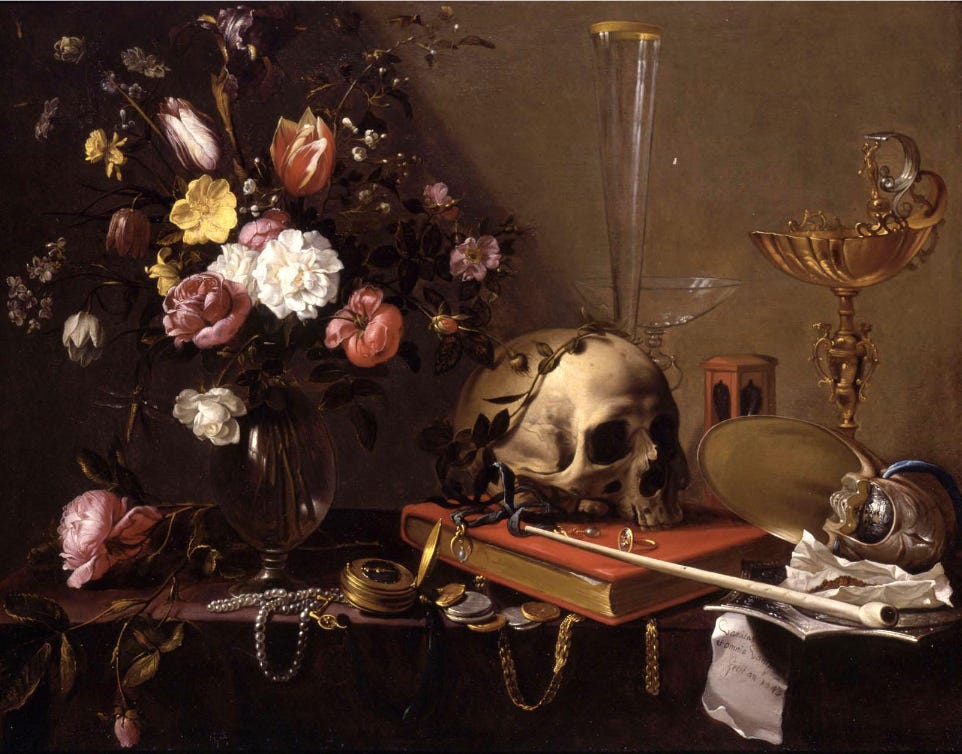
There have always been two ways to make people desire what you are selling. The older way is the secret. You guard the source, the mine or the route or the formula, so that the not-having does its own work and hardens into an ache. The newer way is the story. You bind your wares to love, or eternity, or manhood, so that the customer walks into the shop on his own legs and thanks you for the privilege. Most precious things have lived under one regime or the other, and never had to change. Gold never needed either, because its rarity never failed and, for most of history, half the money on earth simply was gold and silver under other names. The great coloured stones, the emeralds of Colombia and the sapphires of Ceylon and Kashmir, have stayed rare enough that the secret still does most of their work.
The diamond is the strange one, and that is why it deserves the long telling. It is the treasure whose secret failed. Its rarity in the earth collapsed inside a single human lifetime, under the shovels of South Africa, and its worth had to be built again almost entirely out of words. That rebuilding happened recently, and in the open, and the paperwork survived. No other precious stone shows the full passage from the secret to the story so completely, and none left so clear a trail to follow.
It is a long trail, from a fortress in India to a vault in Augsburg to a boardroom in Johannesburg to a copywriter’s desk in Philadelphia, and it is worth walking slowly. One question travels with us the length of it: who poured the meaning into the stone, and what did each of them want in return?
II. Two thousand years of the real stone
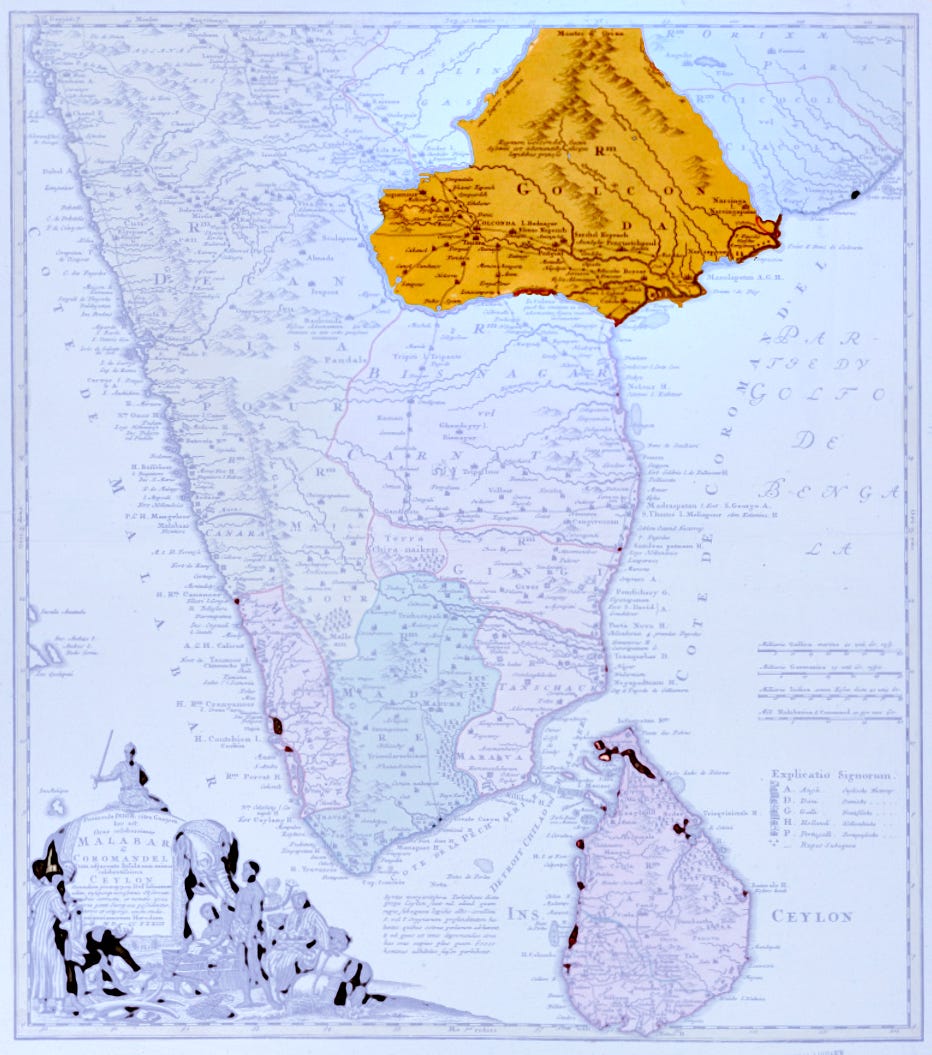
For roughly two millennia, if you held a diamond anywhere on earth, it had come from India. In practice it had come from one region of India: the alluvial fields along the Krishna and Godavari rivers of the Deccan, whose stones were sorted, valued and sold through the fortress city that gave the trade its legend, Golconda.2 Organised digging there reaches back into antiquity, and the stones travelled outward along the trade roads that carried pepper and silk, reaching Persia and Rome and the treasuries of every court that could pay for them. The ancient world already ranked the diamond above all other stones. Pliny the Elder, writing his Natural History in the first century, called adamas the most valuable not only of gems but of everything a man could own.3 In India itself the diamond’s oldest meaning was not romance but power and protection. Sanskrit lapidaries treated the stone as a talisman. The Ratnapariksa of Buddhabhatta promises that the wearer of a flawless diamond gains a strength that overcomes all other powers and makes him master of the land around him. The lapidaries of medieval Europe made the same promise in their own tongue, crediting the stone with power over poison, phantoms and enemies, and the virtue of making its wearer unconquerable in the field.4 Rulers took the promise literally, and they took the stones. Under the Golconda sultans the mining leases, the qaul agreements whose terms have come down to us, reserved any stone above a certain size for the throne by right, so that the greatest diamonds never entered the market at all but passed straight from the gravel to the crown.5
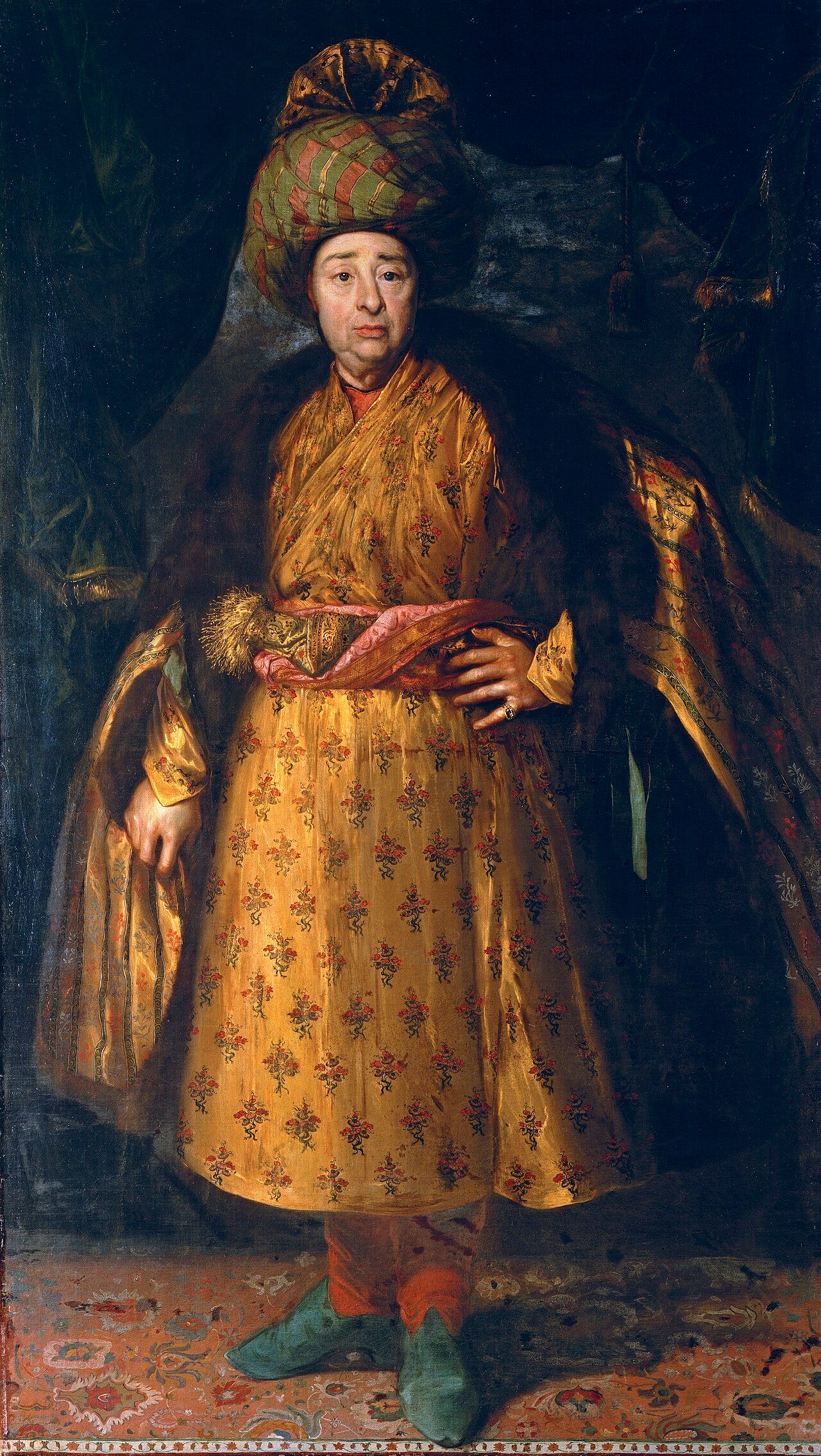
We know what the source of all this looked like because a French jeweller went there and wrote it down. Jean-Baptiste Tavernier, a merchant with a genius for being received at courts, made six voyages to the East between 1631 and 1668 and published his account, Les Six Voyages, in 1676, the eyewitness record on which the later history of the trade leans.6
At the great mine of Kollur on the Krishna he found not a hole in the ground but a society, some sixty thousand men, women and children by his estimate, digging, carrying and washing the river gravels, and he described the stones of the region as gems of the finest water, a phrase jewellers have never stopped using. The finest Golconda stones are what modern laboratories call Type IIa, diamonds almost free of nitrogen, whiter and more limpid than almost anything the earth has yielded since.7 Tavernier priced stones for the Great Mughal himself, and was permitted to examine treasures no other European would ever describe, among them the egg-shaped Great Mogul diamond, now lost, and he carried west the great violet-blue stone he sold to Louis XIV in 1668, which the world now knows, after a theft in the Revolution and a recutting in London, as the Hope.8
Nearly every legendary diamond in existence begins in these same gravels, and their later itineraries read like a history of power written in carbon. The Koh-i-Noor passed from the Mughal treasury through Persian and Afghan and Sikh hands into the British crown, was recut in 1852 to please Victorian taste, and sits today in the Tower of London, claimed by three nations and surrendered to none.9 The Regent, found at Kollur around 1698 and acquired by an English governor of Madras under circumstances he spent the rest of his life defending, crossed to France, survived the Revolution in a Paris attic, and ended set in the hilt of Napoleon’s sword, and rests today in the Louvre.10 The Orlov, a great rose-cut dome that tradition says was prised from the eye of a temple idol, came to Catherine the Great as a gift from a besotted favourite and now crowns the Russian imperial sceptre. The truth of who paid for that gift is a better story than the legend, and it waits for its place further on. The two famous stones of Dresden, one green and one white, are waiting too, a few sections ahead, where their strange history belongs.
Nothing measures what the stones were worth better than the wars fought to seize them. When the Mughal emperor Aurangzeb finally took Golconda in 1687, it was after an eight-month siege that ended not in an assault but with a bribed officer quietly opening a gate in the night, and the conqueror’s men carried the treasury north by camel.11 Fifty years later the hoard changed hands again. Nader Shah of Persia shattered the weakened empire at Karnal in 1739 and sacked Delhi, and carried home the Peacock Throne with the great diamonds still in it. Tradition says that when he first saw the stone we now call the Koh-i-Noor he cried out Koh-i-Noor, Mountain of Light, and named it by accident.12 Armies marched for these stones because the scarcity behind them was a plain fact of the earth. Until the late nineteenth century, by Edward Jay Epstein’s reckoning, the entire world’s yield of gem diamonds came to only a few pounds a year.13 By about 1830 the Indian fields were substantially exhausted, mined out after twenty centuries, and the word Golconda had completed its migration from geography into the English language, where it survives as a byword for boundless wealth, which is history’s small joke, since it was exhaustion that ended it.14
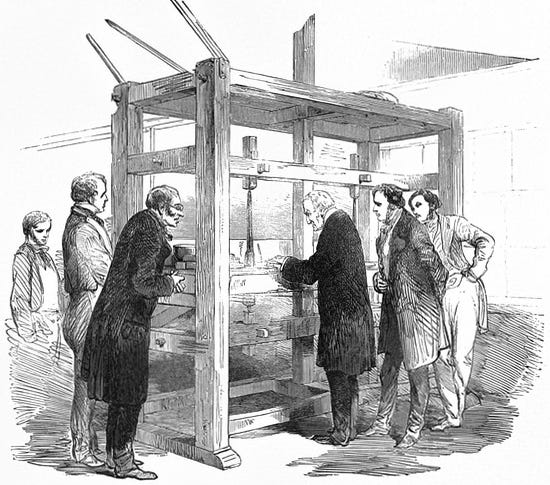
Carry two lessons out of this first age. The scarcity was real. And the meaning was already an invention, only not yet an invention for everyone: talisman, badge of sovereignty, stone reserved by law for the king, meanings fixed to the diamond by the powerful, for the powerful. What the twentieth century added was not the idea that a diamond means something. It took an aura that had belonged to perhaps a thousand people on earth and sold it to everyone with two months’ wages. Before that could happen, the diamond had to pass through a colder chapter of its life, and for that we must go to the Holy Roman Empire, to a merchant of Augsburg who would set himself at the heart of European money and power.
III. The diamond as stored power
In the autumn of 1473 the Holy Roman Emperor, Frederick III, travelled toward the city of Trier for the summit of the age. Two prizes lay on the table at once: a crown for Charles the Bold, Duke of Burgundy, who wanted his duchy raised into a kingdom and himself set among the sovereigns of Europe; and the marriage that would seal the bargain, the emperor’s son Maximilian to Charles’s daughter and sole heiress, Mary of Burgundy. Charles was among the most magnificent princes alive, a man whose court glittered so relentlessly that contemporaries struggled to describe it without inventory lists, and the Habsburgs, who held the supreme title of Christendom and very little cash, faced the appalling prospect of arriving at the negotiation looking poor. The emperor stopped in Augsburg to buy clothes worthy of the meeting and discovered that the city’s merchants, who had lent to him before and regretted it, would not extend credit. One family finally would. Ulrich Fugger, eldest of the weaver-descended brothers whose firm was about to become the greatest commercial house in Europe, advanced the silks and fine wool on credit, dressed an emperor for a wedding negotiation, and took as payment a coat of arms bearing three lilies.15
The summit itself collapsed in mutual distrust. Frederick slipped away down the Moselle with his son by night, days before Charles was to receive his crown, and the marriage itself waited until 1477, after Charles was dead and Burgundy was up for grabs. By tradition, that hurried marriage carried a first of its own, for the betrothal ring Maximilian sent to Mary of Burgundy is commonly cited as the earliest recorded diamond engagement ring. The sources permit us to call that a tradition rather than a certainty, and its irony will be visible from the end of this essay: the custom that a Philadelphia agency would one day sell to the world as timeless does have a genuine ancestor, and the ancestor was a piece of Habsburg dynastic accounting.16 The Fugger family drew a plainer lesson from Trier, and the young Jakob, then fourteen, built the firm on it until his personal fortune amounted, by the time of his death in 1525, to something near two percent of the economic output of Europe: even emperors are beholden to the man who holds the purse.
The wedding never happened. The debt did.17
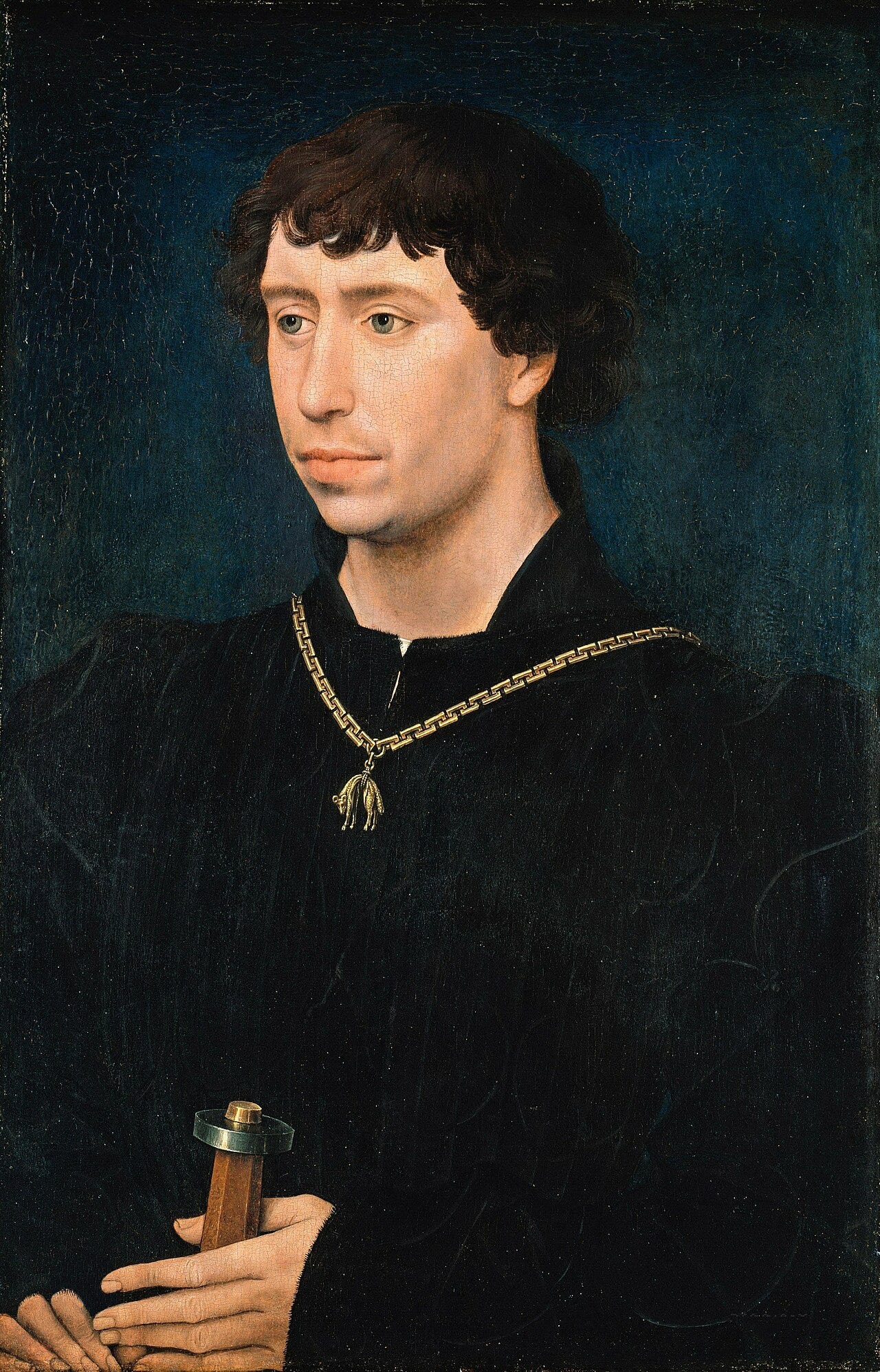
The next chapter in the fall of Burgundy is the reason a diamond enters this story at all. Charles the Bold had a habit, magnificent and fatal, of carrying his greatest treasures with him on campaign, as talismans and as portable proof of his glory. Among them was a jewel his grandfather John the Fearless had commissioned in the late 1380s: three great red spinels of roughly seventy carats each, set in a triangle around a large pointed diamond, hung with heavy pearls, described lovingly in the Burgundian inventory of 1419 and known across Christendom as the Three Brothers.18 At Grandson, on the second of March 1476, the Swiss broke his army so suddenly that the duke fled leaving his camp standing, and the soldiers who looted his tent carried off the Three Brothers, along with, by long tradition, the pale almond-shaped diamond later called the Sancy, which would serve French and English kings in its turn and rest at last in the Louvre.19 The Sancy makes this section’s argument in miniature. A French diplomat, Nicolas de Harlay de Sancy, would later pledge the stone to raise Swiss mercenaries for his king, and tradition holds that the servant carrying it to the paymasters, set upon by robbers on the road, swallowed the diamond rather than surrender it, and that his master had the body opened and the stone recovered. Whatever the truth of the tale, and it is a tale, the use behind it was real enough: a diamond the size of a small almond could hire an army. Within the year Charles himself was dead in the snow outside Nancy, and the richest court in Europe existed only as plunder.
The city of Basel eventually acquired the Three Brothers, and understood precisely what it held. It did something cities do not do for ordinary loot: it commissioned a watercolour of the jewel at exact scale, a sales catalogue in miniature that survives in the Basel Historical Museum, and then hid the piece for a generation, afraid the Habsburgs, heirs of Burgundy, would demand back what they regarded as stolen.
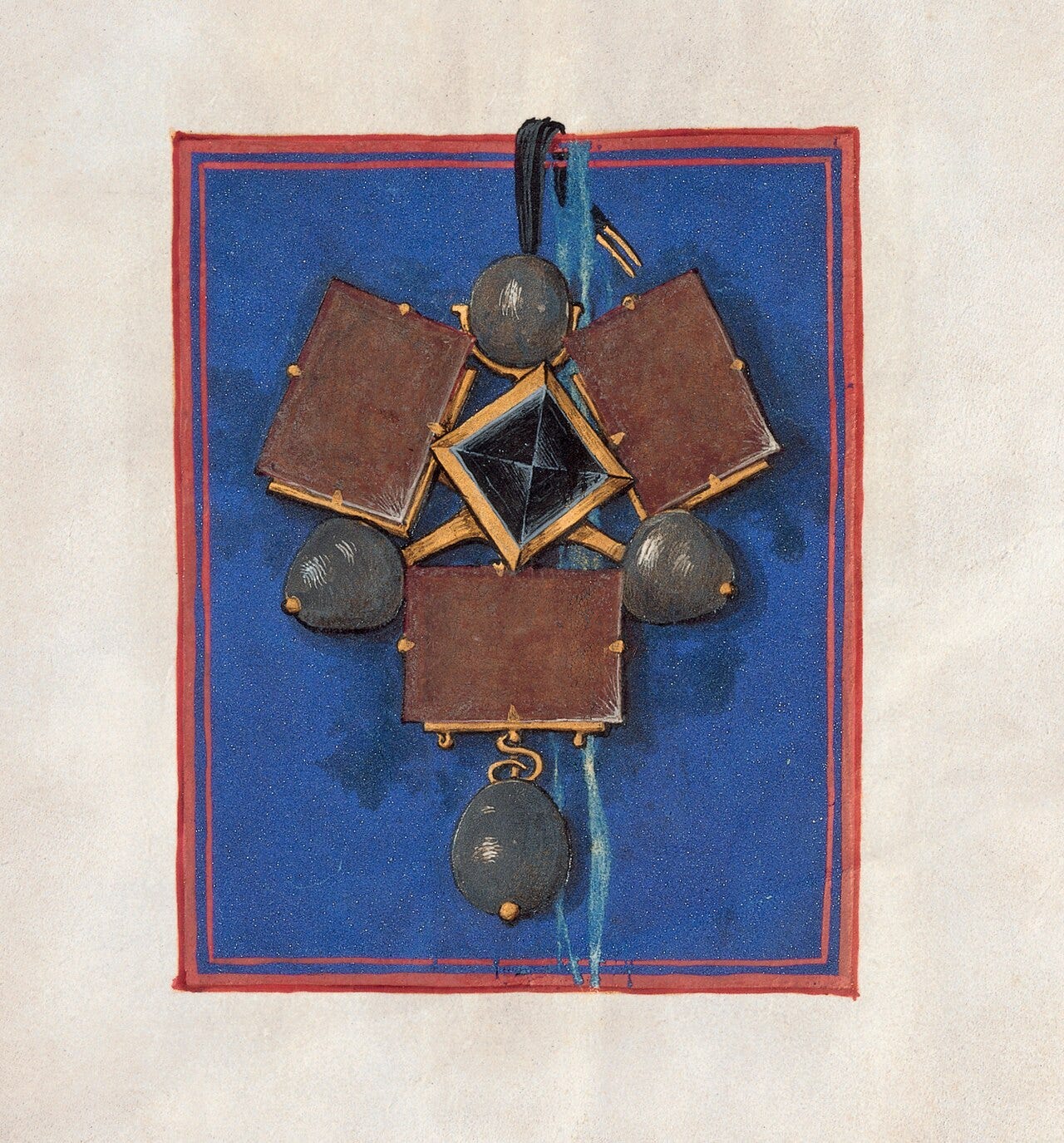
A first, tentative attempt to sell, some ten years after the battle, drew a single offer of four thousand florins, a fraction of the jewel’s worth, because every serious buyer knew the goods were stolen and that the Habsburgs, heirs of Burgundy, might one day demand them back. So when Basel finally dared to sell in earnest, in the early 1500s, it sold discreetly, and it sold from paper. The salesmen who called on Jakob Fugger in his Augsburg counting room carried no stones at all, only painted parchment sketches of the four great Burgundian pieces: a jewelled hatpin called the Little Feather, a heart-shaped ruby called the White Rose, a diamond garter that had belonged to England’s Edward III, and the Three Brothers itself. Fugger studied the drawings, negotiated for more than a year, and bought the complete set in 1504 for a recorded forty thousand florins, a large share of his capital at the time. Then, like Basel before him, he locked the jewels in a vault and said nothing about them.20

Fugger’s reason for buying the jewels tells us what a diamond had become, and it had nothing to do with beauty. He was no collector, and certainly no romantic. Jakob Fugger was the mining and banking magnate of his age, a man who owned copper and silver mines across Tyrol, Carinthia and Upper Hungary, ran the smelters that refined their ore, controlled something close to half of Europe’s copper, and lent the proceeds to emperors and popes. His firm spread its fortune deliberately across cash, land, mines and smelters, merchandise, and precious stones, and the Burgundian jewels went into the books under that last heading: a vast value packed into almost no weight, carriable across any border, pledgeable against any loan, and safe from the debasement that ate away at coin.21 For the four centuries between the fall of Burgundy and the rise of the engagement ring, this is mostly what a great diamond was in Europe. Not a token of love. Collateral, stored value, and power one could hold in a closed fist.
Nowhere does this show more plainly than at the wedding of 1515. The Emperor Maximilian, by then old, chronically indebted and still magnificent on paper, staged in Vienna the double marriage that would deliver Bohemia and Hungary to his grandchildren, the diplomatic masterstroke of the Habsburg centuries. The trouble was that he could not begin to pay for it. Fugger financed the congress, and, by the accounts preserved in the family’s historiography, lent the Habsburgs the jewels of Charles the Bold to wear for the ceremonies, so that the dynasty could stand before the kings of the East dressed in the pawned splendour of the dynasty it had absorbed. When the festivities ended, the jewels went back to Fugger’s vault.22 The empire kept the kingdoms and the merchant kept the stones. Four years later, when Maximilian died and the imperial election of 1519 came down in effect to an auction, the seven electors were bought for roughly 850,000 borrowed florins, of which Jakob Fugger alone found some 543,000, and the crown went to the Habsburg candidate as the Emperor Charles V. Fugger was not shy about what he had done. In 1523, pressing for repayment, he reminded the most powerful man on earth in writing that it is well known that Your Imperial Majesty could not have gained the Roman crown without my help.23
The Three Brothers, meanwhile, still wanted a buyer worthy of it, and the search for one reads like a comedy of European power. Jakob’s nephew and heir Anton Fugger offered the jewel to the Emperor Charles V, who could not or would not pay. An offer came from Suleiman the Magnificent, sultan of the Ottomans, and was refused, the family unwilling to let a treasure of Christendom pass to a Muslim court. So the Fuggers turned at last to the one Renaissance king whose hunger for jewels had no floor, Henry VIII of England, who in a single three-year stretch spent on jewellery what a small city spent on everything it owned.24 Negotiations opened in 1544 and outlived the king. The sale closed in May 1551 under his son, and the paper trail yields something remarkable. The buyer was a boy of thirteen, King Edward VI, and he wrote the purchase into his own journal, recording that he had been obliged to buy the jewel from one “Anthony Fulker” (his English spelling of Anton Fugger) for the princely sum of 100,000 crowns, because the English crown already owed the Fugger bank sixty thousand pounds.25 A child king recording in his own hand that he must buy a dead duke’s battle-looted diamond from his own banker to manage his debts: there is no better sentence in the archives about what a diamond was in Renaissance Europe.
The jewel served the Tudors for nearly a century as exactly what it had been for Fugger: splendour and security fused in a single piece. Queen Mary’s inventory of 1553 lists it item by item, a great pendant bought of the Fuggers in Flanders, three large balasses, one large pointed diamond, four large pearls whereof one hangs underneath, unchanged since John the Fearless commissioned it a hundred and fifty years before.26 Elizabeth I wore it at her breast, where it can be seen in the Ermine Portrait of about 1585, three red stones and a point of white fire on the queen’s black gown.
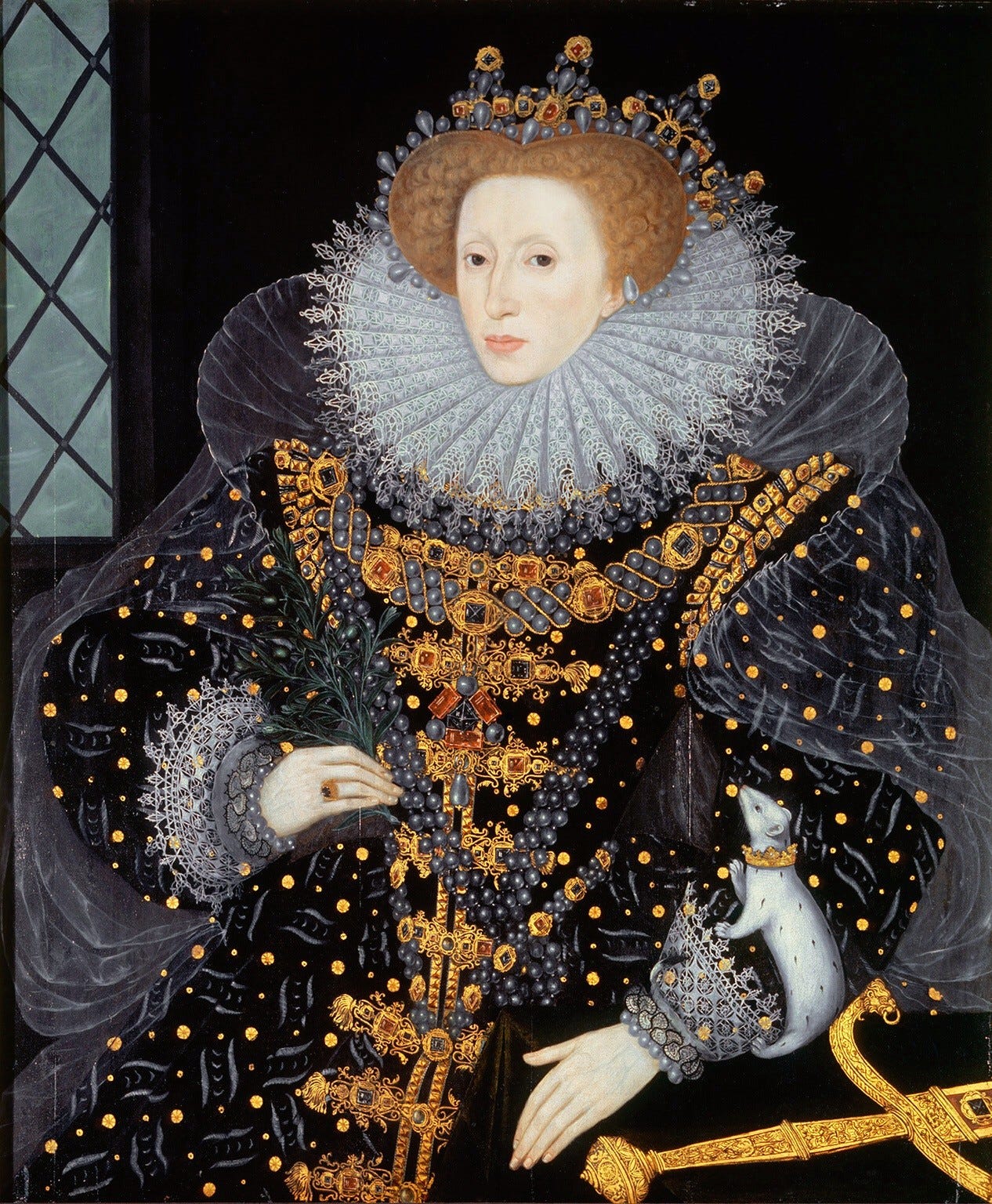
James I wore it after her, and sent his son to woo a Spanish bride with it pinned to his hat.27 And then the logic of collateral completed itself. When the Stuarts slid toward civil war and ready money mattered more than majesty, Queen Henrietta Maria carried the crown jewels to the Continent to pawn for guns, and somewhere in that desperate traffic, around 1645, the Three Brothers disappears from the record forever.28 Looted from a battlefield, hidden by a city, bought by a banker, rented to an emperor for a wedding, sold to a boy king against his own debts, worn by two queens and a king, and finally melted back into money in a war. No one knows where its stones went. The vault, in the end, always opens onto a war.
IV. The scientist who promised diamonds
The next turn in the trail is a promise, made in St Petersburg in the spring of 1829, by one of the most celebrated men of science alive, to an empress.
Alexander von Humboldt was fifty-nine, famous across Europe for the American journey that had made him the model of the scientific explorer. Fewer remembered the earlier and less romantic career that made this Russian venture possible. He was a trained mining man, schooled at the Bergakademie in Freiberg under Abraham Gottlob Werner, and he had spent his twenties as a Prussian mining official in Franconia, raising the yields of failing pits, inventing a breathing device for the men who worked them, and founding a school for miners out of his own pocket.29 It was this Humboldt, the practical geologist, that the Russian crown wanted. In the 1820s vast platinum deposits had been found in the Urals, much of it on the estates of the Demidov dynasty, the iron and mining magnates whose Ural works were an empire within the empire. The finance minister, Georg von Cancrin, was preparing something no state had attempted: a platinum coinage, actual platinum roubles, which his mint would strike from 1828 until 1845. From 1827 he wrote to Humboldt for an expert judgement on the metal and its prospects.30 The correspondence became an invitation, and the invitation became a commission: an expedition across the empire at the Tsar’s expense, with the understanding, plain in Cancrin’s instructions, that the celebrated guest was there to assess Russia’s mineral wealth, its gold and its platinum, for the benefit of the treasury of Nicholas I. Humboldt accepted, on terms that reveal something about both men. A lifelong and outspoken enemy of serfdom, he agreed to keep silent on Russian politics for the length of the journey, and he was shadowed so closely by Cossacks and police that he complained in a letter of not being able to take a step without being led by the arm like an invalid.31
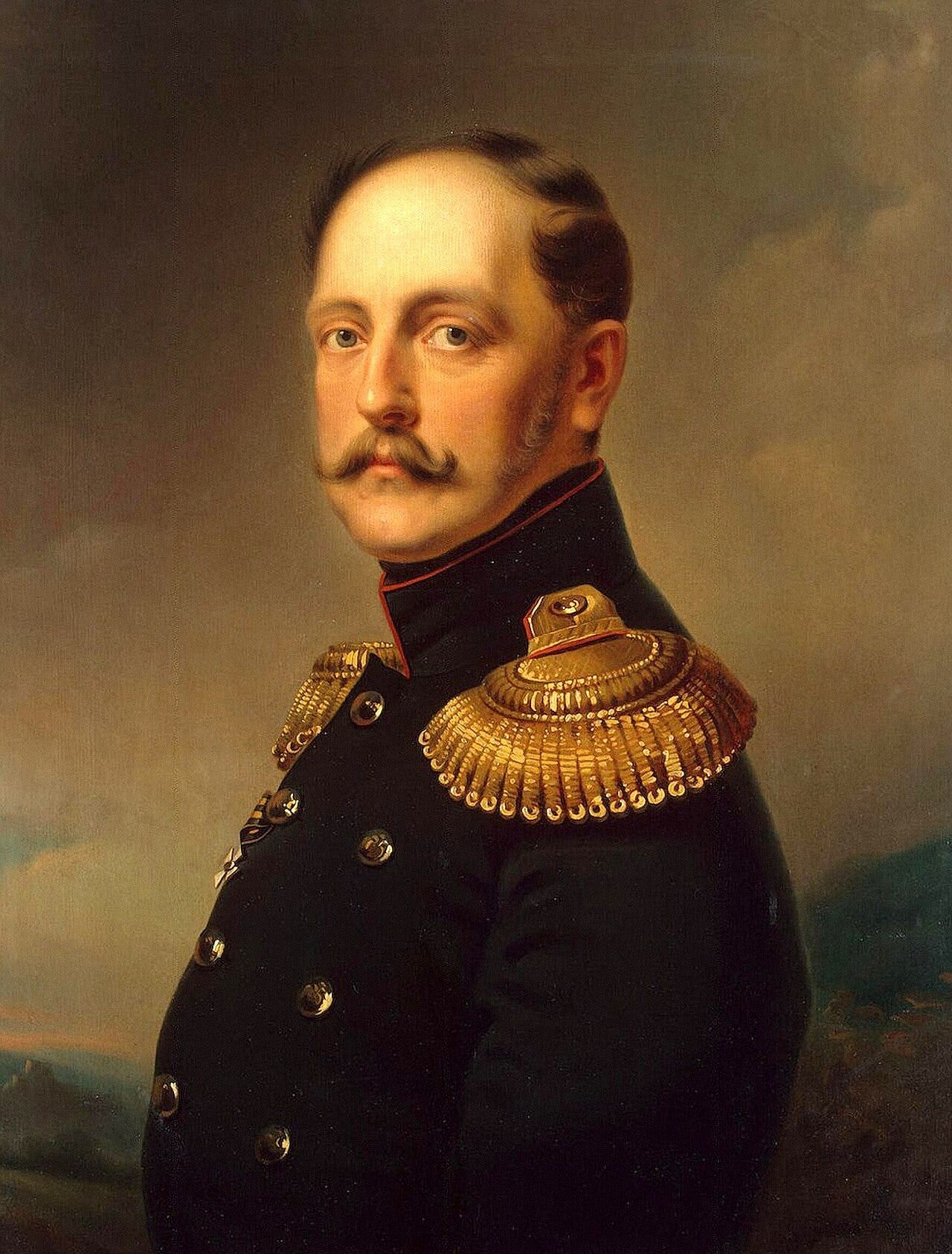
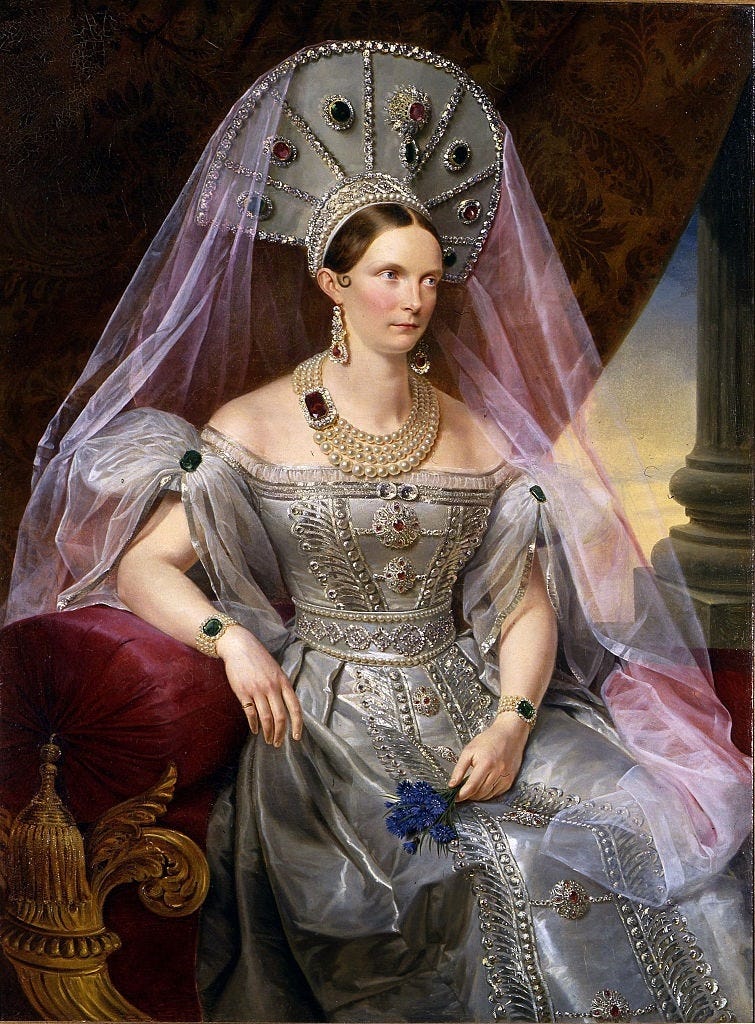
The expedition that left in April 1829, with the mineralogist Gustav Rose and the naturalist Ehrenberg, covered some fifteen thousand kilometres in under nine months, crossed fifty-three rivers, changed horses more than twelve thousand times, and reached past Tobolsk to the Altai on the Chinese frontier.32 Its scientific harvest filled volumes, fed the later industrial development of the Urals through Humboldt’s survey of their mineral wealth, and produced, almost as a parting gift, his successful proposal that Russia string a network of geomagnetic and weather stations across the empire, some of the earliest continental-scale climate observation on earth.33 Before any of that, at a reception in St Petersburg, Humboldt made a promise that startled the officials around him. He told the Empress Alexandra Feodorovna, the Prussian-born wife of Nicholas I, that he would come back from the Urals bearing not only precious metals but diamonds. His escort thought the promise absurd. One of the Cossacks took to calling him the crazy Prussian prince, and by the science of the day the doubt was reasonable, for no diamond had ever been found outside the tropics.34 Humboldt’s confidence came from the habit of mind that ran through all his work: he read one landscape by the light of another. He knew the diamond-bearing gold and platinum gravels of the New World, and the Ural washings matched them mineral for mineral. If the river beds of Brazil carried diamonds among the gold, then the river beds of Perm should carry them too. It was an argument built from pure analogy, made from the window of a moving carriage, against the settled certainty of the entire trade.
It took three months to come true, and it came true because he had made it. Count Adolphe Polier, a French-born nobleman attached to the expedition’s circle, left the party at the end of June for his wife’s estate in the Urals, whose grounds included the Krestovozdvizhensky gold washings near Bisertsk in Perm province. Inspired by Humboldt’s prediction, and this is not a flourish, it is the recorded sequence, Polier instructed his workers to watch the gravel not only for gold but for diamonds. Within days, on the fifth of July 1829, a fourteen-year-old serf boy named Pavel Popov, washing gravel in the ravine that carries Polier’s name to this day, picked out a small hard crystal of about half a carat, the first diamond ever recorded on Russian soil. For finding it he was granted his freedom. Thirty-seven more diamonds surfaced in the district within a month. The first stone travelled, by the fitting logic of the affair, to Humboldt, and Humboldt presented it to the Empress on his return, a promise redeemed to the letter.35
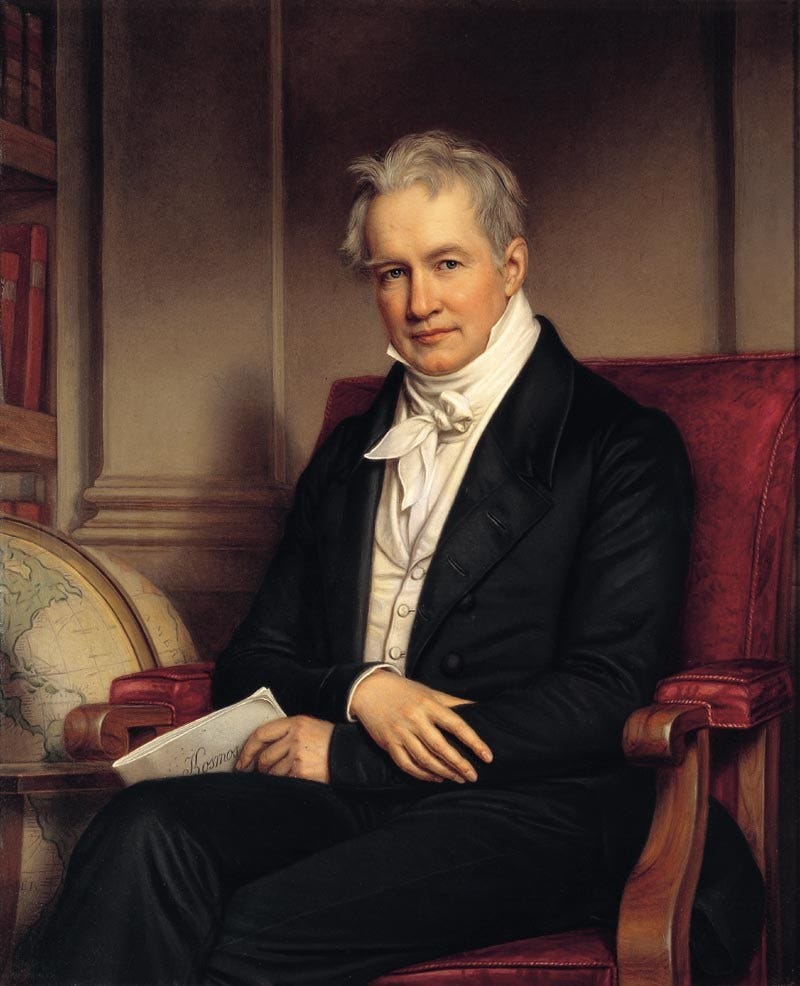
Hold the scene a moment before we move on, because the essay will need it later. Humboldt never once in his life found a diamond himself, not in South America, not anywhere. Brazil’s stones had been found by others, decades before he arrived. What he possessed was rarer: he conjured diamonds out of pure reasoning, against the laughter of his own escort, and the conjuring worked. The prediction produced the search, the search produced the stone, and the stone bought a boy his freedom. A diamond’s worth, that summer in Perm, was exactly what powerful people had decided it would be, a decision that could free a serf as arbitrarily as it had dressed an emperor. And Russia, having celebrated its first half-carat, would matter little to the diamond world for the next century and a quarter, until the day it suddenly mattered more than almost anything, as we shall see. That same year closed the circle on a darker note. A mob in Tehran stormed the Russian embassy and murdered the ambassador, who happened to be the playwright Alexander Griboyedov.
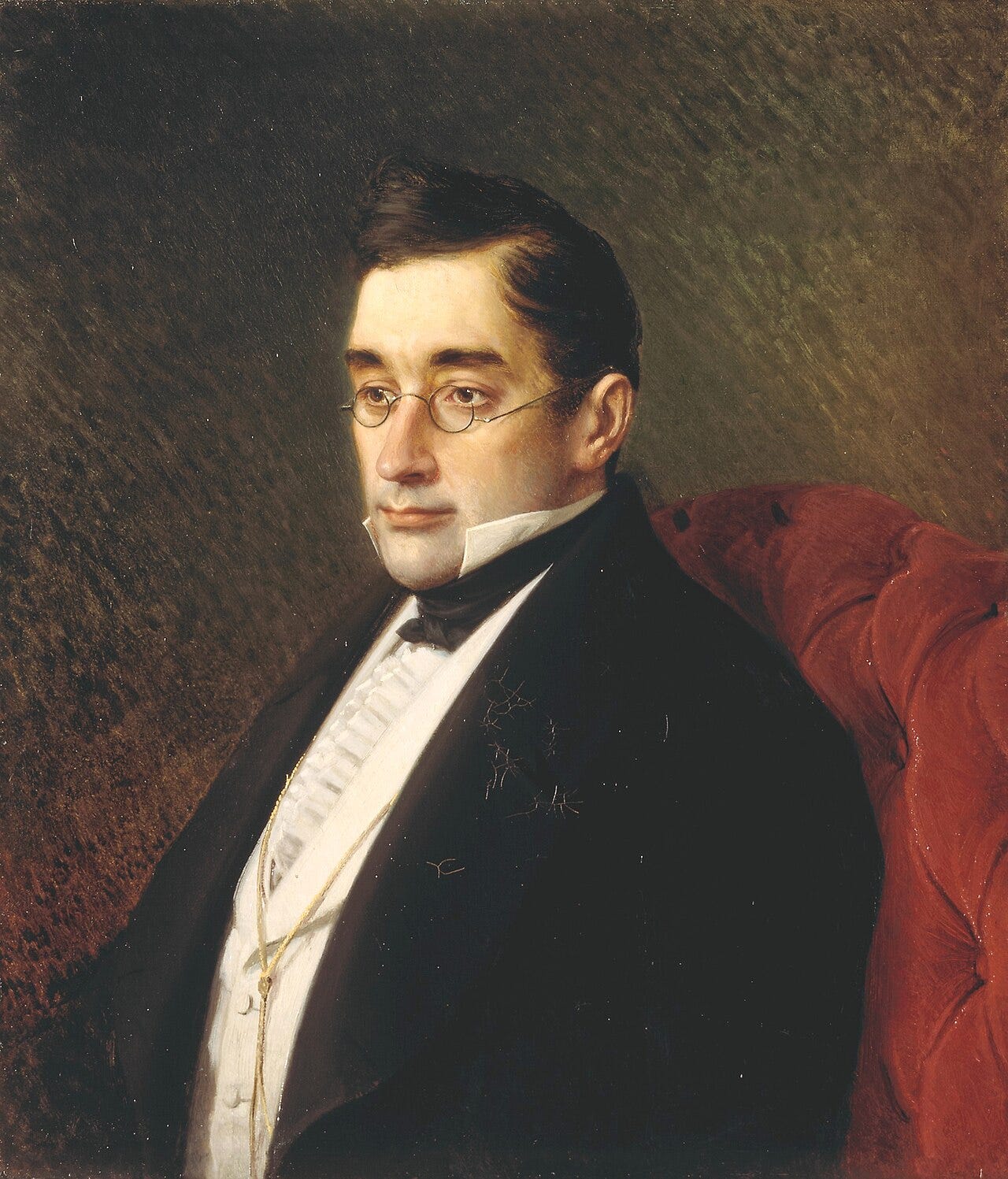
As part of the price of peace, Persia sent the Tsar an 88-carat inscribed Golconda stone the world knows as the Shah diamond, its facets engraved with the names of three centuries of royal owners.36 Russia’s diamond year thus began with a poet paid for in carbon and ended with an empress accepting a freed serf’s half-carat from the hand of a Prussian. Neither stone had anything to do with love.
V. The flood
The age of real scarcity did not end in a single day. But if one had to choose the morning it began to end, a good candidate is a day in 1729 when the governor of Minas Gerais in Brazil confirmed to Lisbon what the gold washers on the Jequitinhonha river had been trading for years, and what the Crown had suspected they were hiding for nearly a decade. The bright pebbles in their pans were diamonds.37 India’s ancient monopoly was broken, and what the Portuguese crown did next deserves far more fame than it has.
Portugal did not celebrate the abundance. Portugal feared it, precisely as London financiers would fear a later abundance, and for the same reason: a treasure that becomes common becomes cheap. So the crown sealed the source. The diamond district around the mining camp of Tejuco, today the town of Diamantina, was fenced off as the Demarcação Diamantina, a forbidden zone with guarded entry, and free residents were barred from mining as early as 1729. An authoritarian Intendency followed in 1734. Then, in 1771, the crown abolished the private contractors altogether and seized the entire trade for itself as the Real Extração, the Royal Extraction, run under a code so notorious it was known simply by the colour of its cover, the Livro da Capa Verde, the Book with the Green Cover. The royal monopoly did not lapse until 1845.38 The digging itself was done by thousands of enslaved Africans, watched as they washed the gravel and searched as they left the workings, the wealth of the district built on their forced labour exactly as it had been at Kollur, and exactly as it would be two centuries later at Kimberley in South Africa.
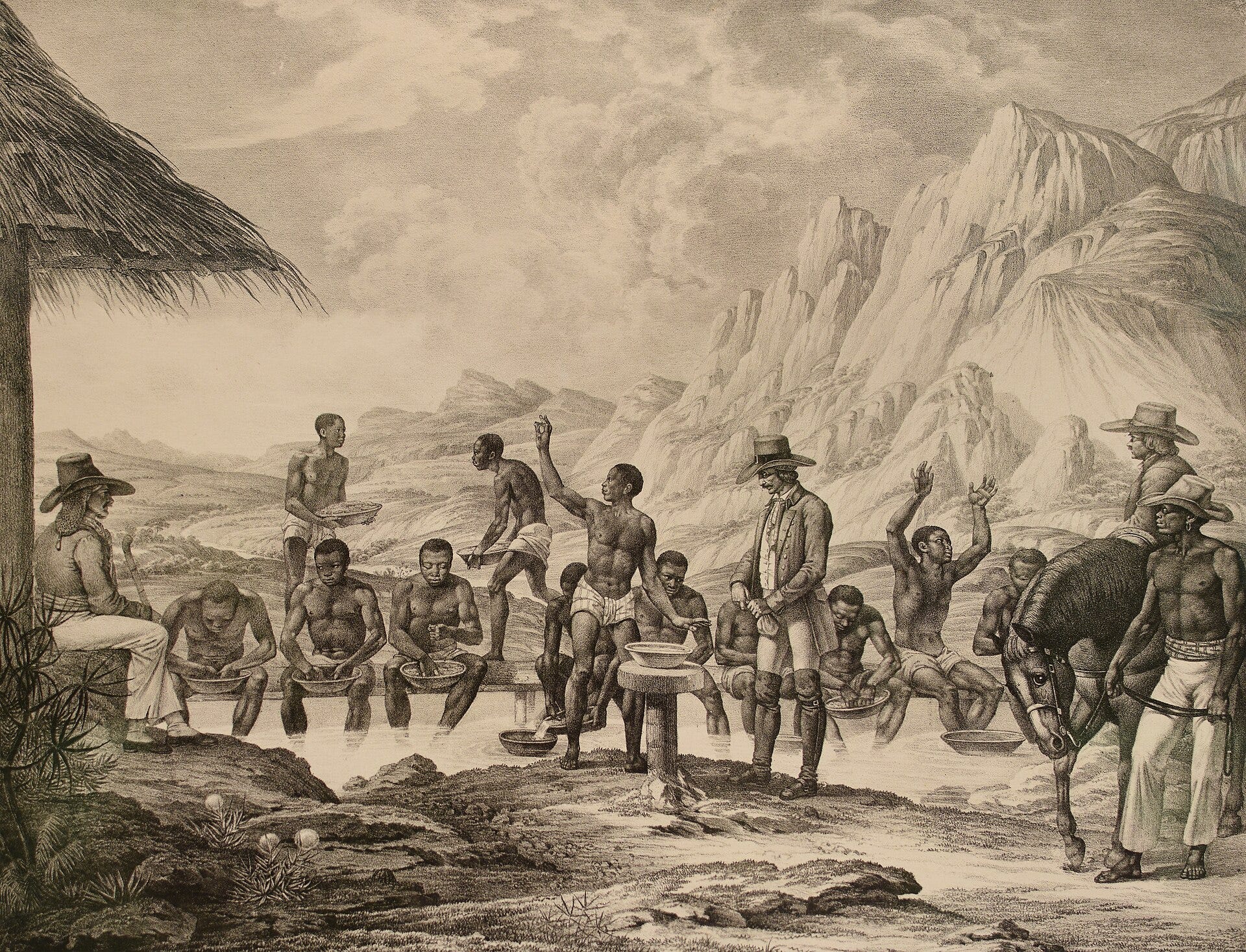
In 1760, in the measure that completes the pattern, the crown created what its own records call the Secret Reserve, a hoard of 241,405 carats deliberately held off the market, a state vault deployed to keep abundance from ever reaching the price.39 Anyone who senses where this essay is heading will recognise the instrument at once, because De Beers did not invent the diamond stockpile. A king of Portugal did, two centuries before. Even the tricks of false provenance are old. when Brazilian stones first reached Europe and dealers sniffed that they were inferior to Indian goods, Portuguese traders shipped them east to Goa and sold them back into Europe as Golconda diamonds, at the full Golconda price.40 The laundering of a diamond’s origins is as old as the second diamond mine on earth.
Brazil carried the world’s diamond supply for more than a century, and the sealed district threw up one of the most extraordinary lives in the story of the trade. Chica da Silva, born enslaved, freed, for years the companion of the royal contractor João Fernandes de Oliveira, presided over the society of Tejuco as its uncrowned queen, a life Brazilian historians have spent careers rescuing from caricature.41 But Brazil was a prelude. The true flood began quietly in 1867, on a farm near the Orange River in South Africa, where a boy named Erasmus Jacobs picked up a bright pebble that a neighbour thought worth passing around. It proved to be a diamond of more than twenty-one carats, named, with the optimism of the frontier, the Eureka. Two years later a Griqua shepherd found a stone of eighty-three carats, the Star of South Africa, and the rush was on.42 It became a deluge in 1871 with the discoveries at the place soon named Kimberley, where the diamonds did not lie scattered in river gravel but ran straight down into the earth in pipes of blue ground, the throats of ancient volcanoes, seemingly without bottom. The Kimberley Central pit alone, by the time it was finally abandoned, had given up more than three and a half tonnes of diamonds. Set that against the few pounds a year the world had known before, and the size of the rupture is plain.43 The photographs of the early Kimberley workings, the Big Hole latticed with thousands of claim ropes, an entire hillside of men digging one shared crater by hand, remain among the strangest images of the nineteenth century, and they were, to the men financing the digging, images of an approaching catastrophe.
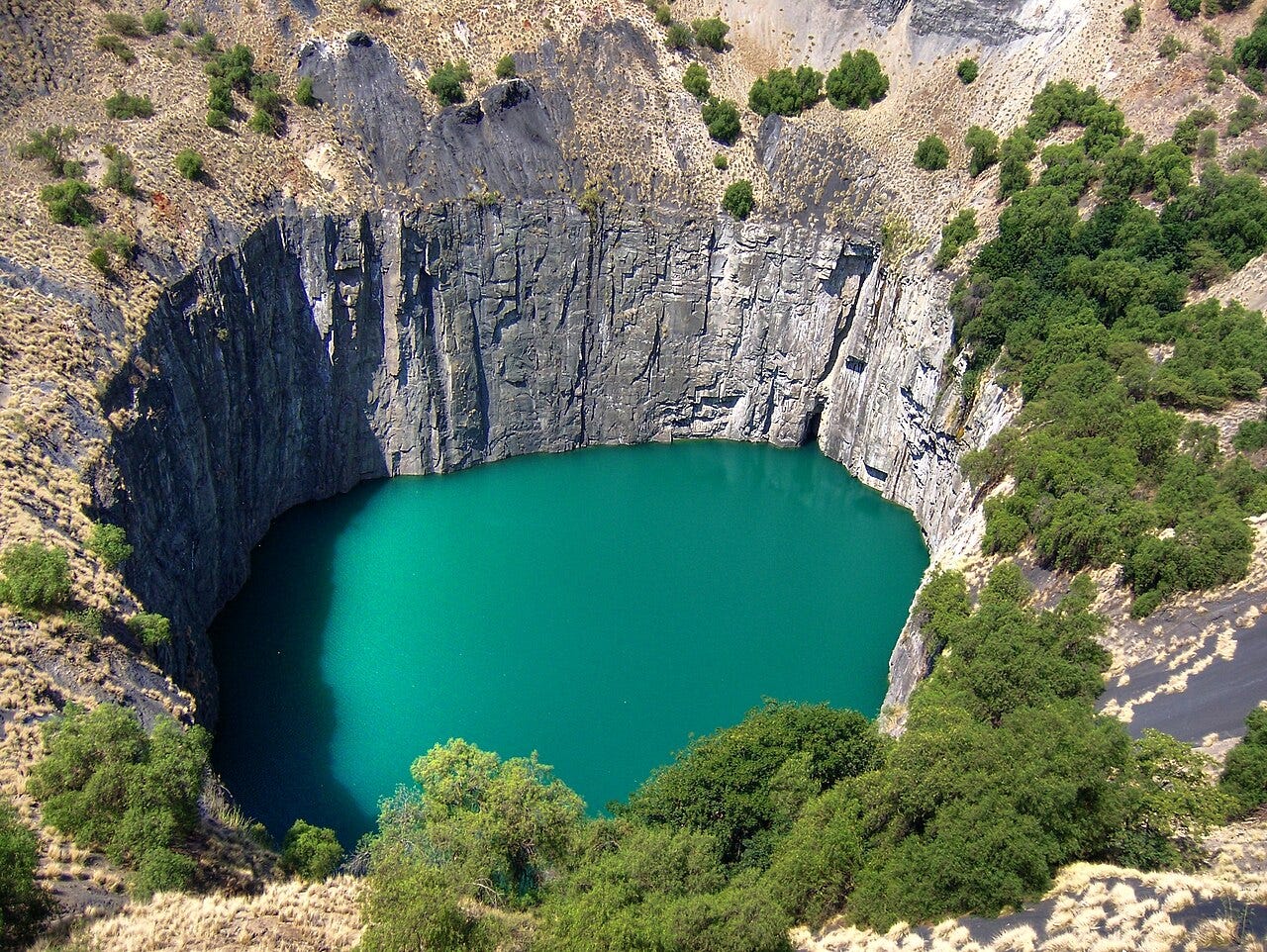
The catastrophe had a precise shape, and every serious man in the trade could describe it. A diamond has almost no intrinsic value; it is not bread, it does not burn, it holds an edge in industry, but gem stones earn their price almost entirely from scarcity and from what people believe they mean. If the pipes of South Africa were worked freely, the market would drown, the price would find the truth, and the diamond would settle into the modest company of the semi-precious. The men who understood this most clearly acted on it. Cecil Rhodes, who had arrived in the diggings as a sickly teenager selling ice and water pumps to miners, spent the 1880s buying up claims, and in 1888, with capital arranged through the Rothschilds, he founded De Beers Consolidated Mines. The buyout of the field’s last great rival, Barney Barnato’s Kimberley Central, was settled the following year, in 1889, with a cheque for £5,338,650, said at the time to be the largest ever written. The company framed it and hung it in the boardroom, where it hangs still.44
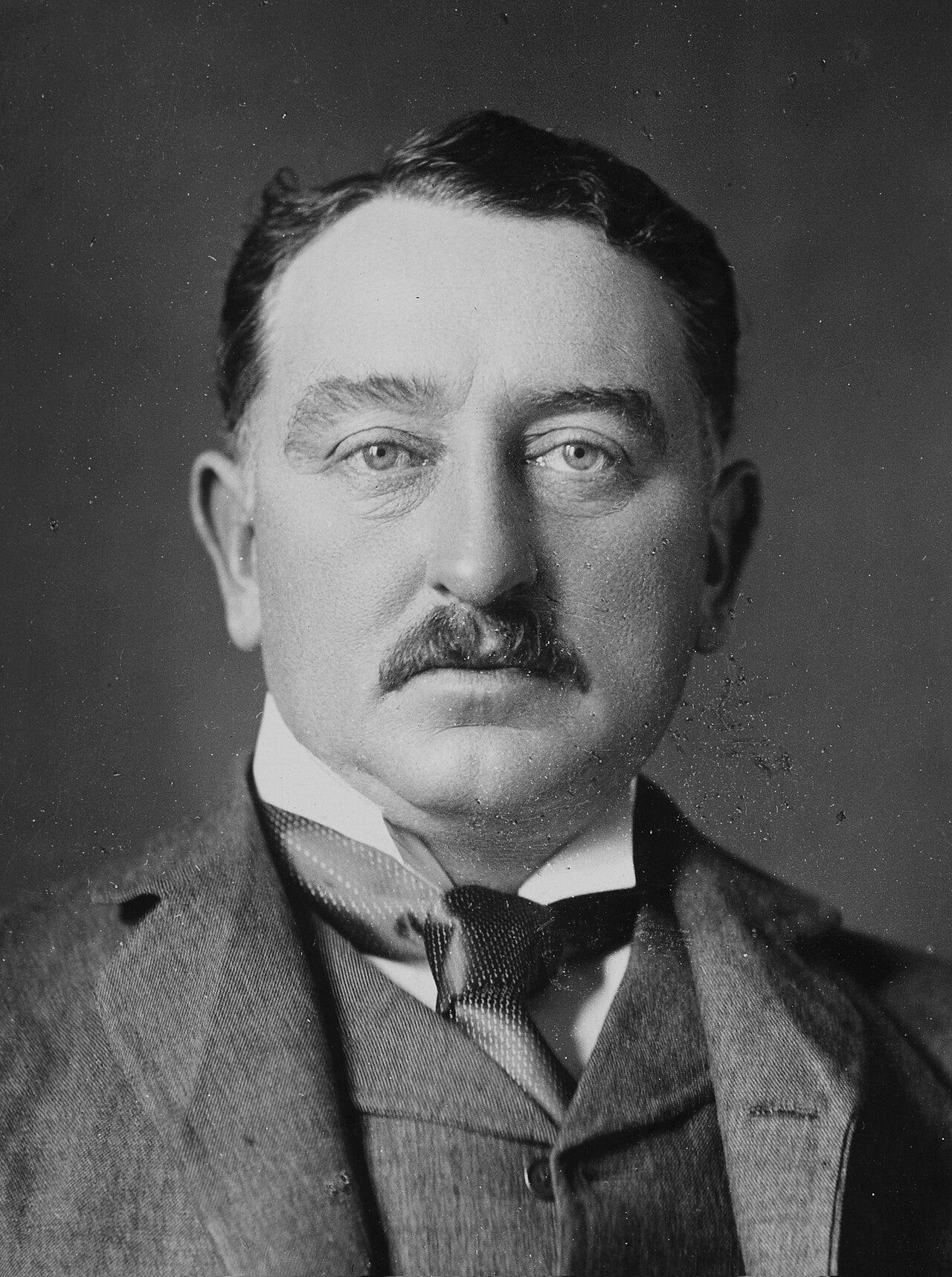
What Rhodes assembled, and what Ernest Oppenheimer perfected after taking the chairmanship in 1929, was something few other trades have ever known: a single channel. De Beers and its allies came to own or contract the mines, and the entire output flowed to one office in London, which traded under the deliberately dull name of the Diamond Trading Company and was known in the business simply as the Syndicate. From that office the world’s rough diamonds were sold ten times a year, at gatherings called sights, to a hand-picked club of cutters and dealers called sightholders. Each sightholder received a sealed box of stones whose contents and price De Beers alone had set, on terms he accepted whole or else lost his seat at the table.45 One office, one price, no appeal. Behind the office stood the vault, the London stockpile into which the company swept whatever the market could not absorb at the maintained price, at times billions of dollars of unsold rough, the Secret Reserve of 1760 reborn at industrial scale.
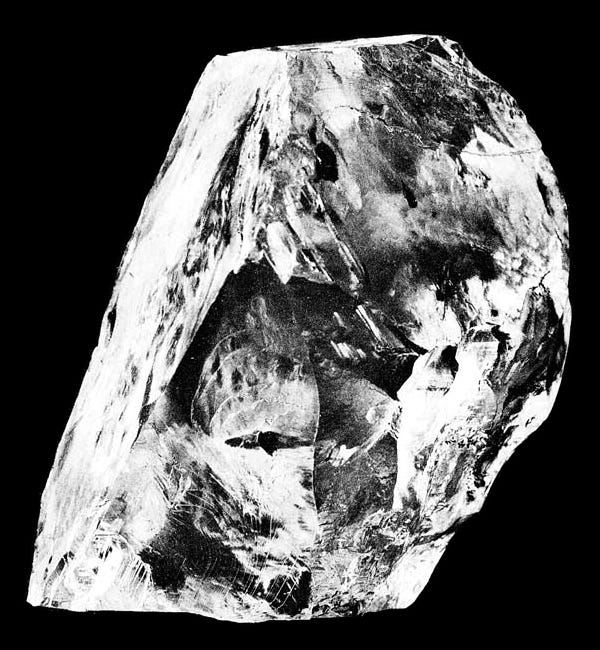
Here is the hinge on which the essay turns, and perhaps the modern industry of desire with it. For two thousand years the rarity of the diamond had belonged to the earth. Now it belonged to a boardroom, renewed each year and guarded by a vault, and what a boardroom decides can always be undone, by a new mine in a new country under a new flag, as the century to come kept threatening to do. The men of the single channel grasped something else as well, sooner than anyone. Holding back supply could protect the price of a thing people already wanted, but it could not make them want the thing more, and through the 1920s the wanting sagged, and in the Depression it fell away altogether. The great American market went quiet. Even the Premier mine sat idle for years for want of buyers. It was the same mine whose discovery the head of De Beers had once waved off in public as a fraud, a salting of the ground with smuggled Kimberley stones, until the earth answered him in 1905 with the largest gem-quality rough ever found, the 3,106-carat Cullinan, cut into the twin stars that sit atop the British sceptre and crown.46
The lesson of abundance was plain. When the secret fails and the vault begins to strain, there is only one place left to make a diamond scarce, and that place is the human mind. Which brings us to 1938, to a young man crossing the Atlantic, and to one of the most consequential meetings in the history of advertising.
VI. Brilliant Illusions
In September 1938 a young man of twenty-nine crossed the Atlantic and took a train to Philadelphia. His family’s bankers at Morgan had arranged the appointment. He came carrying a problem unlike any in the history of selling, because the thing he needed sold could not, strictly speaking, be advertised at all. His family’s company offered no brand, kept no shop, and, as a foreign monopoly wary of American antitrust law, could not so much as put its own name on a page. What do you advertise when there is nothing to buy?
The young man was Harry Oppenheimer, son of the chairman of De Beers. The man he had come to see was Gerald Lauck, president of N. W. Ayer, the oldest advertising agency in America, and the offer was simple: Oppenheimer would pay for the research himself if Ayer could make Americans want diamonds again. Lauck took the account. Over the next twenty years the agency wrote down, for its client, almost everything it did, and those plans and memoranda and yearly reports survived, obtained and quoted at length by the investigative writer Edward Jay Epstein. It is the strange gift at the centre of this story: the makers of the diamond’s modern meaning left a written record of the making.47
The diagnosis came first, and it was bleak. Diamond sales in America had been sliding since the end of the First World War, down by half in carats and by far more in dollars, as buyers turned to cheaper stones or spent their money on the cars and appliances and holidays that Ayer’s memoranda lumped together as “competitive luxuries.” The cure would not be an advertising campaign in any sense the trade had known. It would be the alteration of a people’s mind. The agency’s research showed that young men bought the great majority of engagement rings, so the plan was to teach every young man that the size and quality of the diamond he bought was the measure of his love, and to teach every young woman to expect the stone as the natural beginning of a marriage.48
The agency described its own task with a coldness that still stops the reader. This was, one strategy paper explained, a problem in mass psychology. The aim was to work on the tradition of the diamond ring until it hardened into what the paper called a psychological necessity, a purchase a man simply had to make and a gift a woman simply had to receive, strong enough to win at the shop counter against the refrigerator and the down payment on a car. The audience was counted like territory to be taken: some seventy million Americans over the age of fifteen.49
None of what followed would look like advertising. That was the design.
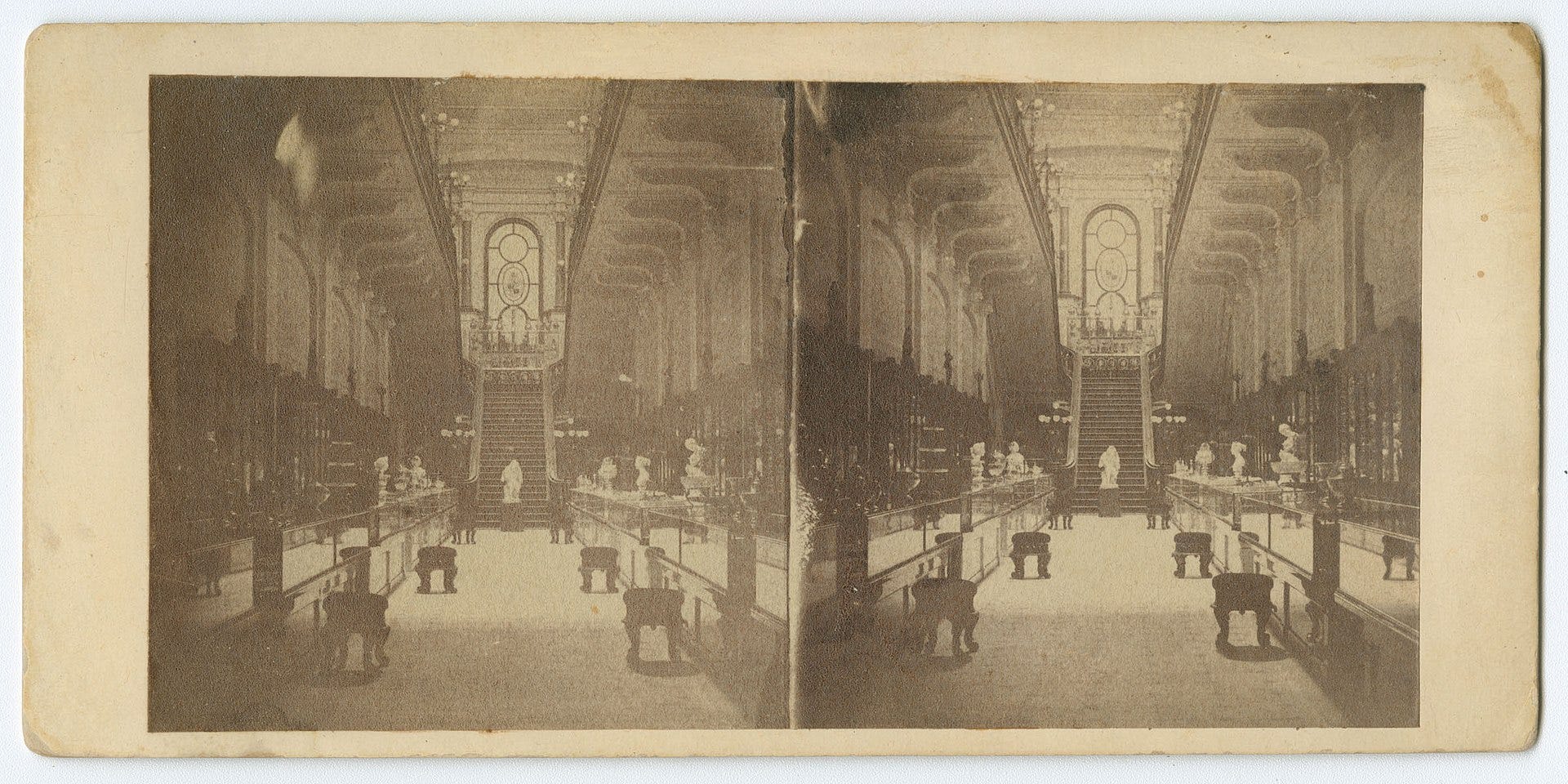
Ayer understood, as Bernays had before it, that people believe from a trusted stranger’s mouth what they discount from a salesman’s, so the campaign was built to arrive from everywhere except a jeweller. Hollywood came first. Films almost never showed a man buying an engagement ring, so the agency went to work on the writers and directors. Its reports record the harvest with quiet pride: a film’s title softened, after conferences with Paramount, from Diamonds Are Dangerous to Adventures in Diamonds; a diamond-shopping scene written into a 1941 comedy for Claudette Colbert. Americans had no diamond tradition of their own, the agency reasoned, so they would take their cue from whatever their favourite stars were seen to wear.50
The press was worked the same way, and more slyly. Paid advertisements were not enough. The deeper aim was to slip into the news and editorial columns and there borrow what the agency called the authority of a disinterested source. So Ayer’s stories went out dressed as news, film stars’ diamonds described each week for a hundred newspapers, the young British princesses arranged into photographs with diamonds on their 1947 tour, paintings commissioned from Picasso, Dalí and Dufy so that an advertisement might hang on the page like a masterpiece. And on any given school morning, somewhere in America, a well-dressed woman was walking into an assembly hall to speak to the senior girls about gems. She was introduced as an expert. She was paid by the trade. By the time the bell rang, several hundred girls knew what a serious man was expected to give the woman he chose. A price appeared almost nowhere in any of it, since a number would only remind the reader that something was being sold.51 By 1941 the agency could report diamond sales up fifty-five percent in three years, and could boast of a new kind of advertising that sold no brand and named no product but planted an idea, “the eternal emotional value surrounding the diamond,” and had even mixed a new colour for the purpose and called it diamond blue.52
The subtlest work was done on the past itself. The ring the campaign was selling was barely older than the campaign, and Ayer knew it, so the agency wrote the ritual a history, its origins and meaning told and retold, in the strategy paper’s own phrase, from our desks to appear in books, magazines and newspapers. It is Bernays’s third-party trick turned upon time: the agency did not merely put its message in a trusted mouth, it manufactured the past in which the message had always been true. Generations came to defend as ancient a custom younger than their own grandparents, and of the two products, the counterfeit history has worn better than the desire.
All the campaign still lacked was its four words, and they came near midnight in Philadelphia in 1947, at the desk of a copywriter named Frances Gerety. She had carried the De Beers account for four years, largely because the agency assumed a woman should write to women. The night’s work was finished except for the line at the foot of the layout. She was tired, and by her own account she put her head down and said, please God, let me get something, then wrote four words and went to bed. In the morning the room was unimpressed, and so, she admitted, was she. The line ran anyway, from 1948, printed beneath a photograph of two honeymooners, because nothing better had come, and within a year it was the company’s signature. A stone that can in truth be chipped, shattered, discoloured or burned to ash had been handed the one word no fact could touch. Half a century later, in 1999, the year Frances Gerety died, Advertising Age would name A Diamond Is Forever the slogan of the century. She never married, and by every account felt no need of the glittering ring she had sold the world.53
The full cunning of that sleepy line shows only once the operation is laid out. On the surface it did the ordinary work of any love slogan, tying the stone to a love that does not fade. Underneath, it solved the one danger that could still have brought the trade down. A diamond is all but indestructible, so every stone ever sold still exists somewhere, waiting to come back onto the market and compete with the new, and the four words barred the way. A diamond that is forever is not an asset to be traded but an heirloom to be kept, and to sell it is not a transaction but a small betrayal of the person who gave it. So the diamonds stayed in their drawers, the second-hand market never formed, and the retail price was never made to face the truth about itself. The agency said as much when it reviewed its own work at the end of the 1950s, congratulating itself on having turned diamonds into cherished possessions, and on having led couples who could not afford a stone to put off the purchase rather than abandon it. And, in a phrase worth reading twice, it praised its own work for having helped keep previous production in the hands of the consumer and off the retail market. Epstein reduced the design to a sentence: the illusion had to be created that diamonds were forever, forever in the sense that they must never be resold.54
The later inventions had the same double bottom. The rule that a man should spend a month’s salary on the ring was pulled from the air by the copywriters, and later, by the same pens doubled to two, an invented figure three generations have taken for old custom. The company itself eventually asked, in print and without blushing, how else could two months’ salary last forever. And anyone who has watched a newly engaged woman walk into her office on a Monday morning knows the campaign’s deepest victory at first hand: the outstretched hand, the ring tilted to the light, the friends leaning in, the arithmetic running silently behind every smile, and later, among the man’s own friends, the same arithmetic spoken out loud. The agency built that gauntlet. Almost nobody remembers that it was built. Veblen’s conspicuous consumption, which readers of this series last met among the champagne bottles, appears in the files by name, recommended as a tool: the diamond was to be sold as the one success a man could make visible, worn on another person’s hand.55
And then the culture finished the job for free. In 1949 a Broadway musical gave the world a song called Diamonds Are a Girl’s Best Friend, and in 1953 Marilyn Monroe sang it in Gentlemen Prefer Blondes in a shocking-pink gown that became one of the most copied images of the century.
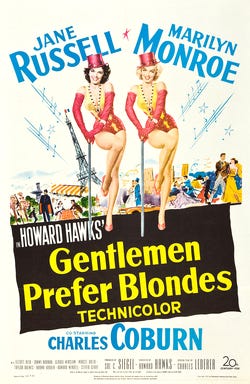
The diamond trade could not have written the scene better had it paid for every frame, and here the costume records hand us an irony almost too neat to be true. The jewels Monroe wears in that hymn to diamonds are not diamonds. They are paste and rhinestone from Joseff of Hollywood, glittering under the studio lights, while the one real stone attached to the picture, the 24-carat yellow Moon of Baroda, was lent to her only for the publicity tour, and travelled apart from the film, as marketing. The most famous celebration of diamonds ever put on screen was performed in fakes, and no one in the audience could tell, because no one in the audience was ever meant to look at the stones. They were looking at what the stones had been made to mean, which was the whole point, and the whole product.56
The numbers say the rest more plainly than any sentence could. On the eve of the campaign, about one American bride in ten received a diamond. By its mature years the figure was near four in five. De Beers’ wholesale sales in the United States ran to some twenty-three million dollars in 1939 and had passed two billion by 1980, a near hundredfold rise, on an advertising budget that grew over the same years from two hundred thousand dollars to ten million. The ritual it built, defended at a thousand family tables as old as marriage itself, is younger than the zip fastener, younger than the ballpoint pen, younger than most of the people who grumble that the young have abandoned it. It was designed, in the exact sense that a bridge is designed, and the drawings still exist, in an agency’s files and a museum in Washington, where anyone may go and read them.57
VII. The experiment repeats
A sceptic could still object that America was ready to be sold romance, a young, movie-fed, prosperous country with a genius for sentiment, and that the campaign merely surfed a wave that was coming anyway. The objection deserves an answer, and the diamond trade, without ever meaning to, ran the experiment twice and left the results for anyone to read.
The first came through fiction. In 1956 Ian Fleming borrowed the slogan, reportedly with the company’s blessing, for the fourth James Bond novel, Diamonds Are Forever, and the borrowing went deeper than a title, because Fleming had sources inside the fortress itself. De Beers by then operated a private intelligence service, the International Diamond Security Organisation, created to fight smuggling from the African fields, and it had recruited as its chief no less a figure than Sir Percy Sillitoe, the recently retired head of MI5. Fleming interviewed the organisation’s men and published the result in 1957 as a non-fiction book, The Diamond Smugglers.58 Sit with that arrangement for a moment: a commercial cartel running an intelligence service staffed from the top of British counter-espionage, its exploits written up by the creator of James Bond, whose fictional title, when the film arrived in 1971 wrapped in Shirley Bassey’s voice, broadcast the cartel’s four-word slogan to every cinema on earth, free of charge, forever.59 No public relations department in history has been handed such a gift, except that it was not entirely a gift, since the title had been lent in the first place.
The second answer was Japan, and it is as close as the history of advertising has ever come to a controlled experiment. Japanese marriage was, into the 1960s, among the most conservative institutions in the developed world. Matches were arranged through go-betweens, and the union was sealed in the Shinto rite by bride and groom drinking rice wine from a shared wooden cup, a form little changed in a thousand years, with no courtship, no proposal scene, and no ring.
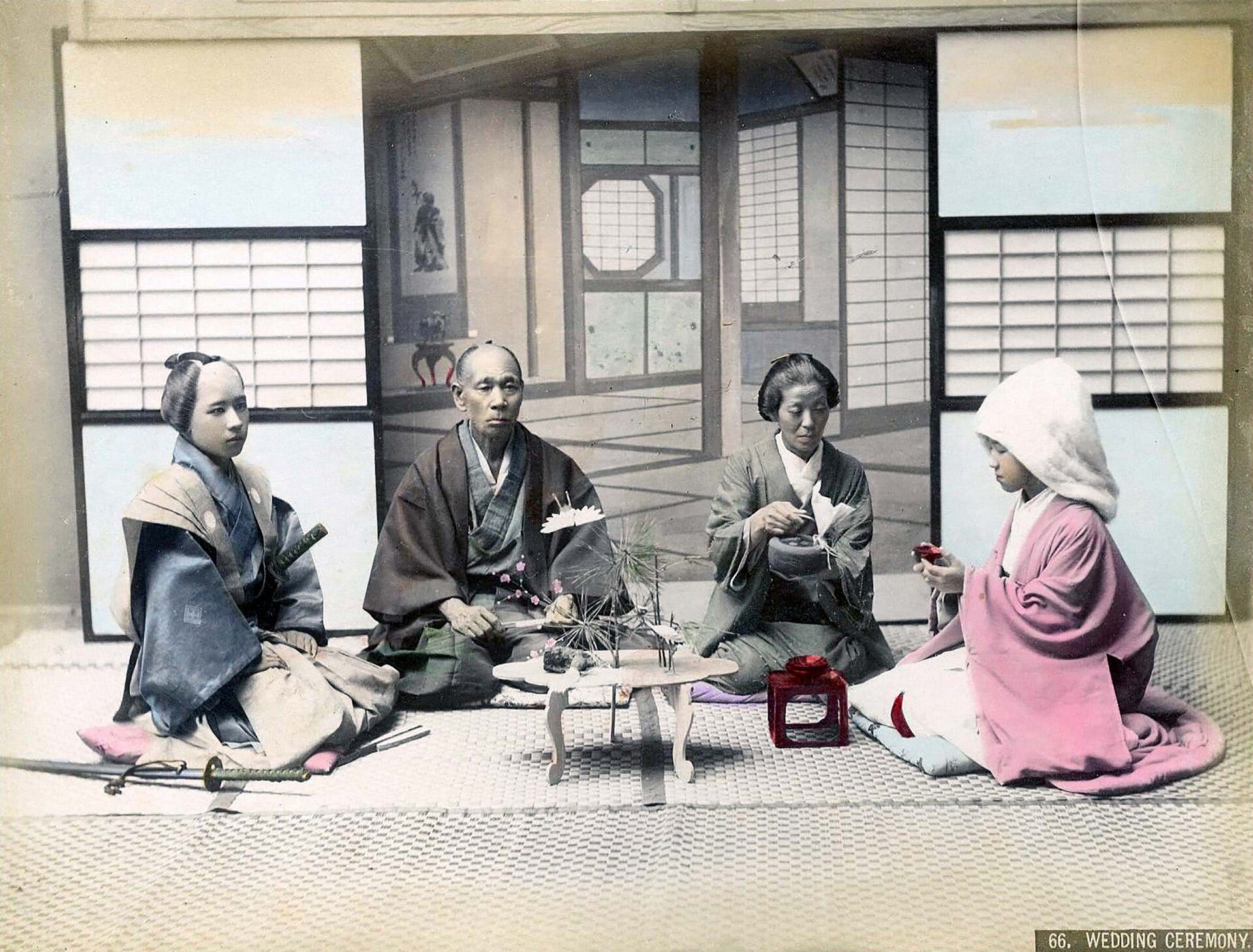
In 1967 De Beers retained J. Walter Thompson, then the largest advertising agency in the world, to install the Western ritual in this least Western of markets, and the campaign did not even pretend the custom was Japanese. It sold the diamond not as a Japanese custom, which it plainly was not, but as a small act of rebellion against Japanese custom, the badge of a couple choosing each other over the arrangements of their parents, placed on the fingers of young women shown skiing and swimming and driving into a modern life. It worked with a speed that ought to unsettle anyone who believes traditions run deep. Fewer than five percent of Japanese brides wore a diamond in 1967. Within a generation, more than sixty percent did, and a country that had married without the stone for a thousand years had become the second largest diamond market on earth.60
Fourteen years, one agency, and a millennium of custom rewritten.
Whatever the diamond ring is, it is not a Western peculiarity that other cultures resist. It is a manufactured desire that takes hold wherever the same patient work is done, which is precisely what Le Bon’s cold little book had implied about human beings in general, and what no one before the diamond trade had ever demonstrated on an entire civilisation with a before-and-after chart.
VIII. The cartel’s secret ally
While the agency was rewriting courtship, the vault faced the gravest supply threat in its history, and the way it was resolved is the least known episode of this story and the most deserving of attention: it required the Cold War, briefly and secretly, to stop.
Soviet geologists had reasoned since the late 1930s, by exactly Humboldt’s method of analogy, that the Siberian craton should hold diamond pipes like South Africa’s, and after the war the search became a state priority, driven not by romance but by the industrial stones, the abrasives and drill points, that a manufacturing economy starves without.61 The breakthrough belongs to a Leningrad team and, above all, to two women. Natalia Sarsadskikh of the VSEGEI institute worked out the method, tracking the blood-red mineral pyrope, a travelling companion of diamond, upstream through the river gravels like a scent. Her colleague Larisa Popugaeva carried it into the field, and on the twenty-first of August 1954, on a riverbank in Yakutia, she cut into blue ground studded with pyropes and found Zarnitsa, the first diamond pipe ever discovered outside Africa. The following June, geologists extending the method found the deposit that changed the world market, Mir, and announced it to Moscow in a coded radiogram whose pun survives translation: we have lit the pipe of peace, the tobacco is excellent.62
What was done to Popugaeva afterwards the Soviet diamond industry took decades to admit. She had prospected in ground claimed by a powerful rival expedition, the Amakinsky, and its officials held her for months at their remote Nyurba base, questioning her and refusing her leave to go home until she signed her discovery over to them. They then claimed it as their own. For years the woman who had found Russia’s diamonds was left off the monuments, and formal recognition reached her only in 1970, while her colleague Sarsadskikh waited until 1990.63 The serf boy of 1829 was freed for his half-carat. The geologist of 1954 was broken for her pipe. The diamond has never had much sentiment to spare for the people who actually find it.
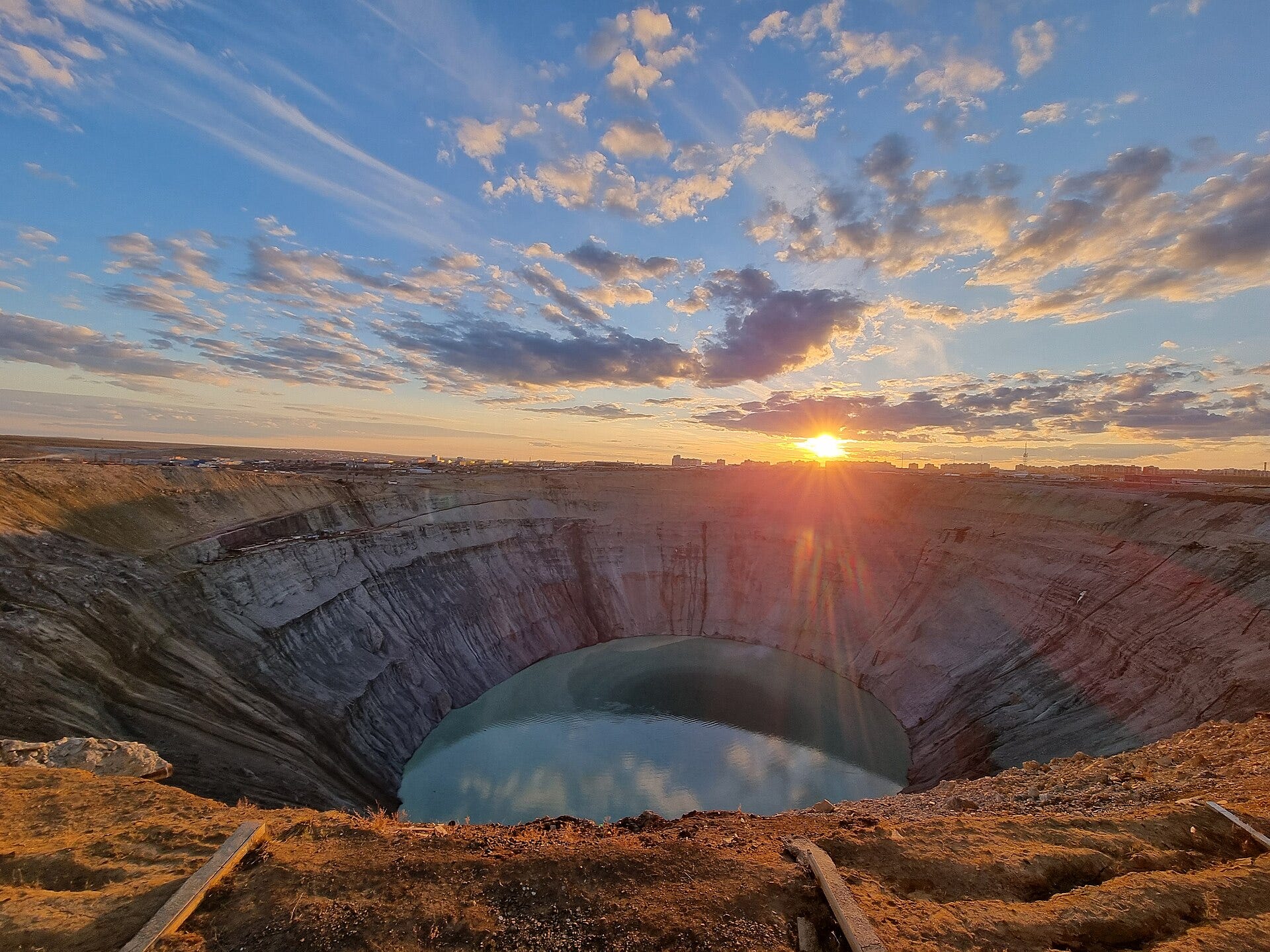
Production began in 1957, and the men in London saw at once what Siberia meant. The mere news of the Soviet finds had knocked a quarter off the De Beers share price. A state outside every Western arrangement, sitting on pipes of unknown depth, could pour stones into the market and break the single channel in a season. Instead came one of the purest demonstrations of interest overruling ideology the century would produce. The apartheid-era South African cartel and the Communist Soviet Union struck a deal. The arrangements ran through the state agency Almazjuvelirexport and through front companies in Luxembourg and Switzerland, so that neither side’s public would ever see the handshake. De Beers bought the overwhelming bulk of Soviet gem rough, by the usual accounts on the order of ninety-five percent of it, paid a premium for it, and fed it into their own channel with everything else.64 Harry Oppenheimer told Epstein, across a desk in Johannesburg in the late 1970s, what the arrangement was worth to Moscow: more than half a billion dollars in the previous year, a stream of hard currency second only to oil, along with the industrial stones that Siberia’s own mines could not yet supply. Asked whether the Soviets might one day break away and compete, he answered with a question of his own. What could the Russians possibly gain by competing with us?65
Moscow, which denounced monopoly capitalism at every party congress, joined what Epstein called the most successful cartel in the annals of modern commerce, because the sums of the vault respect no scripture: flooding the market would have devalued the same stones the Soviet state needed to sell. For decades, while the two systems pointed missiles at each other, their diamonds travelled to market in the same box, at the same maintained price, under the same four-word slogan. Arrangements of that kind last exactly as long as every party needs them, and the second half of the century is the story of the need running out. Anti-apartheid politics strained the Soviet tie from the 1960s and forced it deeper underground. The collapse of the Soviet Union broke it open. In the chaotic 1990s, even as a cash-starved Moscow signed one last billion-dollar contract, stones leaked from the Yakutian stockpiles into Antwerp at a rate estimated at a further billion a year, and the industry that became ALROSA learned to sell for itself.66
Australia’s Argyle mine, the largest on earth by volume and the source of nearly all the world’s rare pink diamonds, walked out of the cartel in 1996. Canada opened world-class mines at Ekati in 1998 and Diavik in 2003 and marketed their stones on the one quality De Beers could never claim, clean provenance, while independent traders, most famously the Israeli cutter Lev Leviev, went around the single channel to the source countries themselves.67
American antitrust law, which had kept De Beers from operating directly in the United States for decades, closed its long pursuit only with a settlement approaching three hundred million dollars, finalised in 2012.68 A distribution empire that had controlled some eighty-five percent of the world’s rough in the 1980s held less than sixty percent by the early 2000s. Soon after, De Beers formally abandoned the single-channel system and remade itself as one competitor among several in an open market. The classic cartel was over.
Here is the part that ought to astonish: its passing made almost no difference to the diamond. The price did not collapse. The ritual did not fade. The engagement ring did not follow the cartel into history, because by the time the old apparatus of supply was dismantled the scarcity had already moved elsewhere. It now lived where Ayer had put it, in the mind, held in place by meaning alone, by a grip on sentiment that no new mine under any new flag could loosen. The secret had built the diamond’s price. The story was what kept it standing.
Money itself made the same crossing in the same century. Gold, scarce by nature, gave way to paper supported only by promise, and the world barely noticed, because the diamond had rehearsed the trick in public for fifty years. Goethe had staged the discovery earlier still: in Faust, it is the devil who teaches a bankrupt emperor that paper, signed with enough authority, can stand for treasure yet buried in the earth.
IX. Have you ever tried to sell a diamond?
The question that stands as this section’s title was put to the readers of The Atlantic in February 1982 by the investigative writer Edward Jay Epstein, and it remains the sharpest test anyone has found for what a diamond actually is, because everything the campaign built is arranged to keep you from asking it.69
Epstein, working from interviews that reached Harry Oppenheimer himself and from Justice Department files prised loose under the Freedom of Information Act, assembled the account of the trade this essay has drawn on throughout, and its sharpest edge is the arithmetic of the counter. The retail markup on a diamond commonly ran to one or two hundred percent. A jeweller asked to buy a stone back, on the rare occasion he would do it at all, offered wholesale or less. So the ordinary buyer who tried to sell learned, usually in one bruising afternoon, that the token of forever gave up a third to a half of its price at the shop door. If a ring sleeps in a drawer of your family, it is part of this reckoning too. It has simply never been tested. This is not a scandal in the ordinary sense, because it is not a deviation from the system. It is the system. The maintained retail price was never a market price. It was an invented one, and the taboo against reselling, the forever, was the wall that kept the invented price from ever being tested against a real one. Modern finance has since run the numbers with academic patience and reached Epstein’s conclusion in flatter language: as an investment the retail diamond is illiquid, hard to price, hard to compare, and lacks the safe-haven steadiness of gold.70 The diamond is a superb store of meaning. It is a poor store of value, and the gap between those two sentences is the profit margin of one of the most successful campaigns of the twentieth century.
The last threat to the diamond’s price came not from any mine but from a laboratory, and the trade had seventy years’ warning of it. In 1955 the General Electric Company announced that it had made diamond out of ordinary carbon, the commonest element on earth, and the agency’s files record the reflex: soothing stories placed in the press, the trade counselled, in Ayer’s own phrase, on communicating a relaxed point of view.71 For decades the laboratory stones stayed small and grey and industrial, and the reassurance held. Then, in the 2010s, the technology grew up, and gem-quality crystals began coming out of the machines that no eye and few instruments could tell from mined ones, for there is nothing there to tell apart: they are diamond, atom for atom, the same stone with a shorter past. What came next is the plainest lesson this story has to give. The price of laboratory diamonds fell, as the price of anything that can be manufactured must, while mined stones held their ground behind a wall built of nothing but adjectives, real, natural, earth-grown, a billion years in the making. In 2018 De Beers itself, after years of swearing it would never stoop to selling synthetic gems, launched a laboratory-diamond brand of its own. It priced the stones cheap and flat, on the frank reasoning that a stone grown last Tuesday deserves no aura, and that the aura belongs to mined diamonds alone. By the mid-2020s, on industry counts, something close to half the engagement stones sold in America were grown in a factory, larger and cheaper than the mined ones and identical to them under every test.72 The house that taught the world a diamond is forever now spends its advertising money teaching a subtler lesson, that only the diamonds of the earth carry the story, and it concedes the entire case this essay has been making. Once the stone itself can be copied at will, the story is no longer part of the value. The story is the value. And that is no scandal peculiar to diamonds. It is how crowns and currencies have always worked. The diamond is only the place where the trick is small enough to fit on a finger.
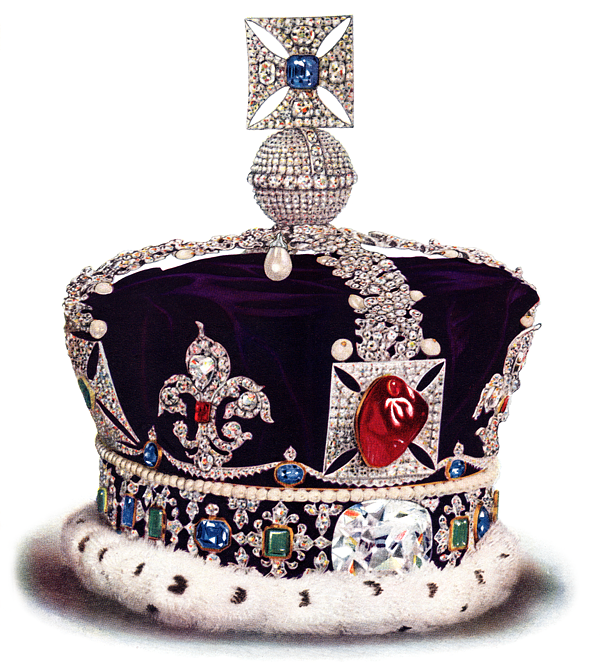
Here the story must complicate itself, as honest stories do. At the top of the market, the rarity was never invented at all. Above the world of the mall jeweller there is a second market, thin, ancient and real, where the genuinely scarce stones trade, and there the prices are made the honest way, by rich people bidding against each other in public. A single flawless pink, the Pink Star, sold at auction in 2017 for more than seventy million dollars, a price real in the way the two-months-salary rule never was.73 The greatest stones of all have no numbers at all, which is the most telling fact in the market. The Koh-i-Noor, the Hope, the Regent, the Dresden Green: their values are estimated, sometimes extravagantly, but never tested, because the nations that hold them can never sell, and a stone that can never be sold has no price at all, only a story.
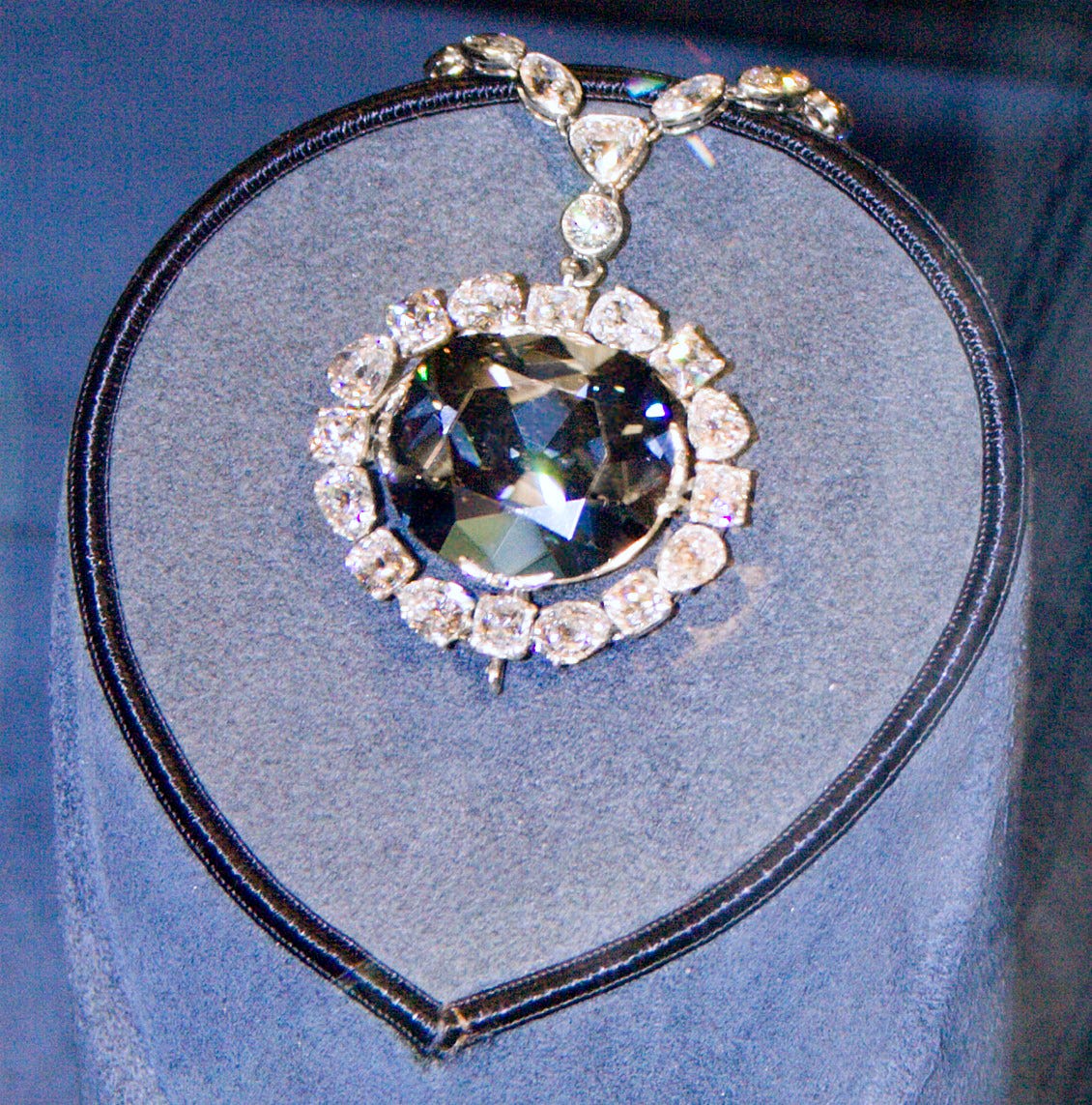
It is the quiet final joke of the subject. After all the vaults and cartels and campaigns, the only diamonds on earth without a price are the ones with the longest stories, which tells you, more precisely than any economist could, what the price of every other diamond is actually made of.
X. Blood and greed
There is one stretch of the trail the romance was built never to reach, and it cannot be left out.
The very quality that made a diamond the ideal treasure for a king, a great fortune folded into something you could hide in a fist, made it, in the 1990s, an ideal way to pay for a war. In Sierra Leone and Angola, rebel movements paid for years of killing by digging diamonds out of riverbeds and selling them into the ordinary trade. These were wars fought with a particular cruelty, remembered for the hacking-off of civilians’ hands and for the rifles put into the arms of children, and the dead were counted in the tens of thousands. The stones that paid for Sierra Leone’s terror left the country through neighbouring Liberia, whose president, Charles Taylor, took a cut in guns and was in the end convicted of war crimes.74 The industry’s answer, in 2003, was the Kimberley Process, a scheme of certificates meant to prove a rough diamond had clean origins. It helped. But the traffic fell chiefly because the wars themselves ended, and the certificates were written to catch rebels rather than governments, so that stones dug under army guns in Zimbabwe passed as clean. A diamond, in the end, serves whoever holds it, and the same weight of worth that fills a treasury can pay for an atrocity.
That is one shadow the sparkle throws. There is another, lighter one, and to find it we go to Dresden.
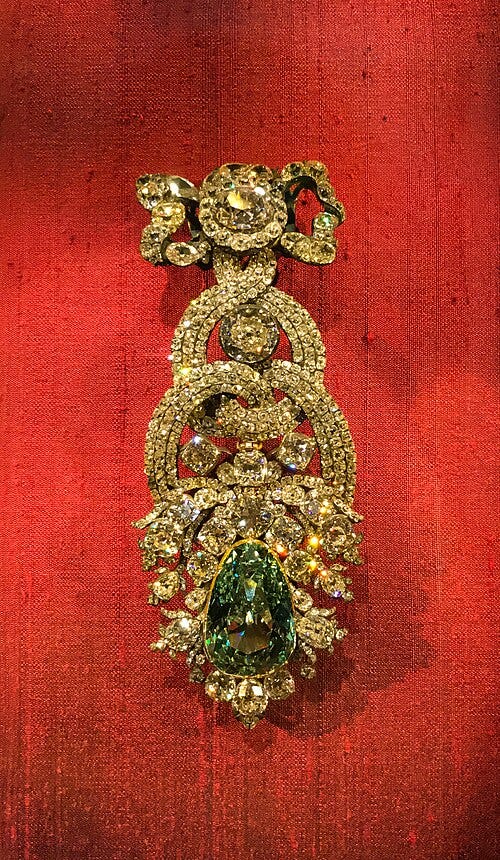
The Green Vault is the treasure chamber that Augustus the Strong, Elector of Saxony and King of Poland, threw open in 1723, and it was a piece of theatre from the start, splendour staged as an argument for the dynasty that owned it.75 Augustus was the last great prince of the old duke’s persuasion, the creed Charles the Bold had carried into the mud at Grandson, that treasure is heaven’s favour made visible. The Dresden Green, forty-one carats of Golconda green, reached Augustus’s son by way of the Leipzig fair of 1741 and cost four hundred thousand thalers, about twice what Dresden was then spending to build the Frauenkirche, the Baroque church whose great stone dome was raised to rival Saint Peter’s in Rome.76
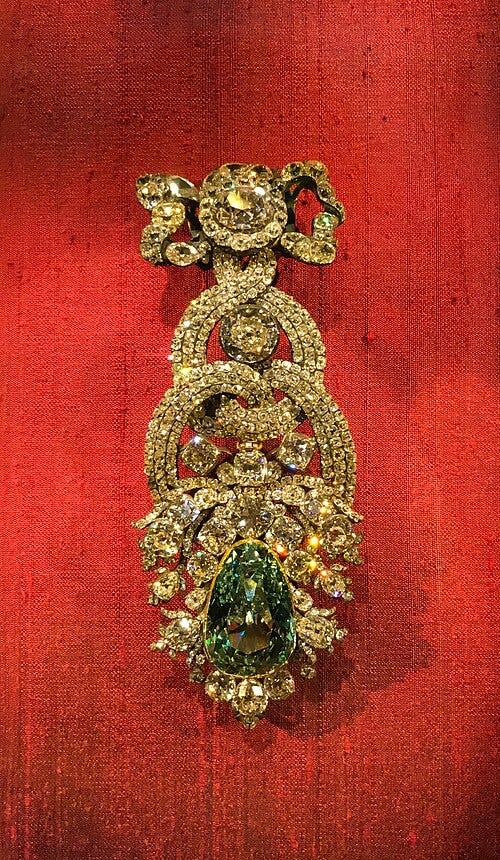
The Dresden White, nearly fifty carats and colourless, was, carat for carat, the dearest white stone yet sold: two hundred thousand thalers, half the price of the Green.77 For a glittering generation after 1746 the two were set together in one badge of the Golden Fleece, until war pulled the badge apart and each went its way, the Green into the hat clasp it still wears, the White into the heart of a great diamond epaulette.78 The collection came through the Seven Years’ War, the firestorm of 1945, and thirteen years as Soviet trophy art before its return in 1958.79 What it did not come through was the small hours of the twenty-fifth of November 2019, in one of the largest jewel robberies in modern history. Thieves killed the streetlights from a power box beneath the Augustus bridge, cut through a grille, and swung an axe into the glass cases of the Jewel Room, and were gone four minutes later with more than four thousand diamonds, the White’s epaulette among them. The Green alone was spared, an ocean away in New York that night, on loan to the Metropolitan Museum.80
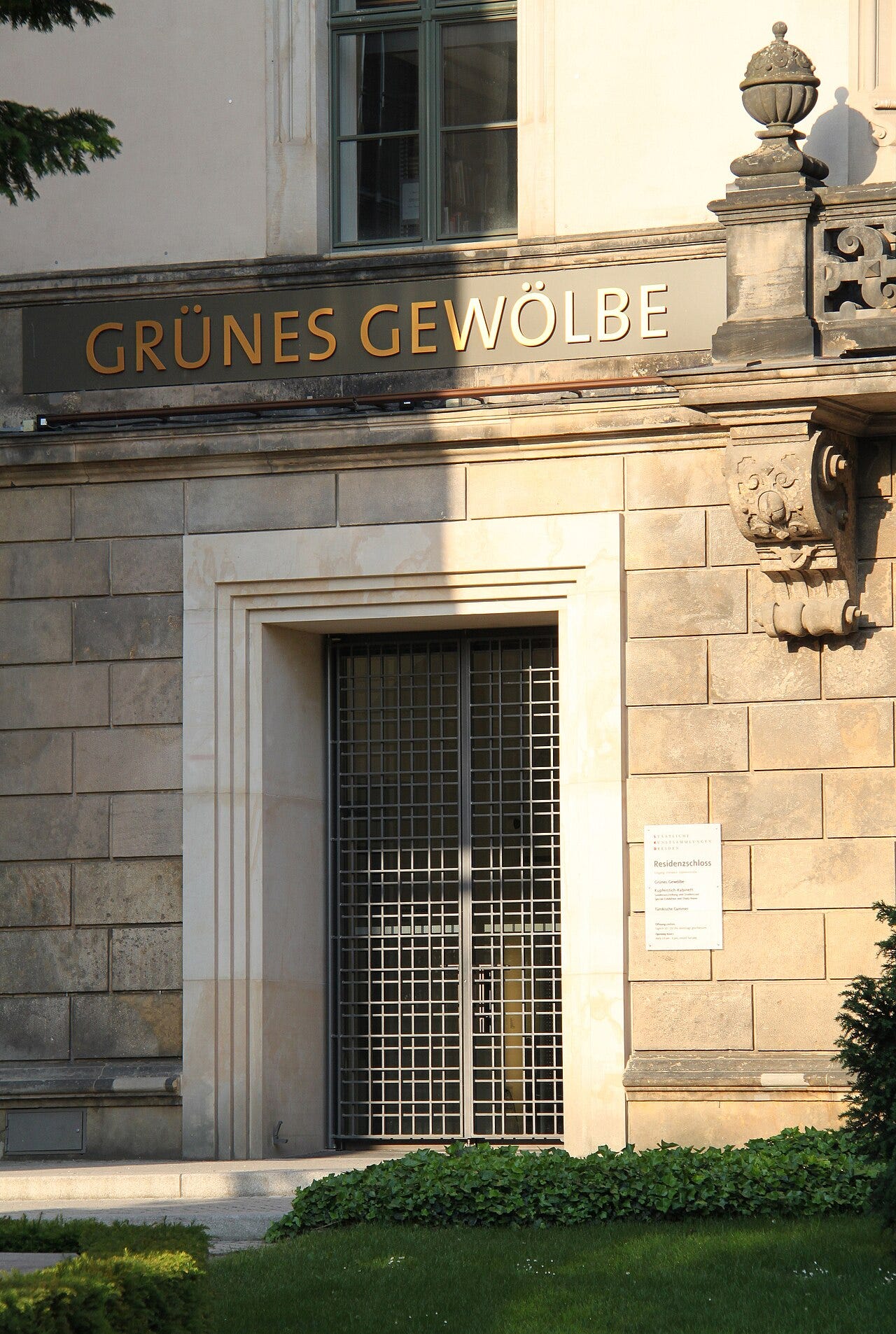
Dresden’s thieves were caught. They came from a Berlin family already famous in the annals of crime for carrying a hundred-kilo gold coin out of the Bode Museum, and that coin tells the moral in miniature. Within days it was cut up and melted, and all that survived of it was dust of five-nines gold on the robbers’ clothes, the ruined treasure helping to convict the men who ruined it. The Dresden case ended in a bargain: five men convicted in 2023, the convictions upheld by Germany’s highest court in 2024, and thirty-one of the stolen pieces handed back, lightly damaged, through their lawyers. Saxony is now pursuing the family through the civil courts for a reported ninety million euros, on the sound principle that men who cannot return a treasure can at least be made to pay for it, though a clan fortune has proved as hard to seize as a melted coin.81 The answers to the questions everyone asks are unromantic. Prosecutors valued the haul at 113 million euros, far below the billion of the first headlines, because the worth of such pieces is historical, which makes them nearly impossible to sell and, for that reason, nearly impossible to steal. No insurer paid, because German state collections carry their own risk, so the people of Saxony, for now, have borne the loss of treasures their ancestors’ taxes paid for three centuries ago.82
The Dresden White has not come back. The stone for which Augustus paid a great fortune, the white half of the jewel of 1746, sits somewhere in the dark as this essay goes to press, and those who know the trade fear the likeliest outcome. It has probably been cut into anonymous fragments, its history stripped away for safety, and with the history the greater part of its worth. The pieces would still be diamond, and would still sell, but the three centuries that made this particular stone priceless would be gone, exchanged for the plain price of the carbon. To break up the Dresden White is to take a diamond that was forever and make it ordinary, which is the slogan’s own undoing. And if that is what happened, then the White has only gone where the Three Brothers went before it: into the dark where the great diamonds sleep.
The night carries the lesson this essay has been moving toward. No one burns out the streetlights and swings an axe in the dark for something nobody wants. The heist is the shadow the campaign casts, and a shadow is proof of the light. Every vault in this story, the fortress at Golconda, the locked chest in Augsburg, the sealed district in Brazil, the stockpile in London, the bright rooms on the Elbe, was raised to guard the same fierce, manufactured, and now entirely genuine desire.
Epilogue
Frances Gerety died in April 1999, in the year her midnight sentence was named the slogan of the century, having spent a working lifetime writing love for a mining company and having, by every account, felt no need of the product herself. Larisa Popugaeva, who found the buried pipes that made the Soviet Union a diamond power, was held at a remote base until she signed the discovery over to the men who had not made it. Her diploma as discoverer reached her sixteen years late, and the town that grew from her find raised her monument only when she was no longer alive to see it. Pavel Popov, a boy of fourteen washing gravel in a Ural ravine, walked out of serfdom for a single half-carat crystal, which is to say that a diamond once bought a man his freedom at a price set entirely by what other people had decided the stone should mean. And somewhere tonight the Dresden White sits in the dark, whole or in pieces. Of the four, it is the one whose story is not yet finished, and may already have been taken apart.
Further reading
For readers who wish to go further, a short and opinionated shelf. Edward Jay Epstein, The Rise and Fall of Diamonds (1982), remains the indispensable investigation of the modern trade, and the author has placed the full text online. Stefan Kanfer, The Last Empire: De Beers, Diamonds, and the World (1993), tells the cartel’s story at length. On the Fuggers, Greg Steinmetz, The Richest Man Who Ever Lived (2015), is the liveliest way in, and Mark Häberlein, The Fuggers of Augsburg (2012), the fuller scholarly account. Andrea Wulf, The Invention of Nature (2015), brings Humboldt vividly to life. On Brazil, Júnia Ferreira Furtado, Chica da Silva (2009), restores an extraordinary life to history. On the stones themselves, William Dalrymple and Anita Anand, Koh-i-Noor (2017), and Richard Kurin, Hope Diamond (2006), are both excellent. And on the world the campaign built, Tom Zoellner, The Heartless Stone (2006), follows the diamond from mine to finger to resale counter with a reporter’s eye.
Notes and sources
1. The two-tier structure of diamond rarity, genuine at the top of the market and managed in the middle, is set out in Edward Jay Epstein, The Rise and Fall of Diamonds (1982), and in the industry analyses of Paul Zimnisky, A Brief History of De Beers.
2. On Golconda as effectively the world’s sole significant source for some two millennia, see the survey literature summarised in Golconda Diamonds (Wikipedia, with its cited scholarship) and Capucine Juncker’s recent study of the Golconda stones.
3. Pliny the Elder, Naturalis Historia, Book 37, on adamas as the most valuable of all possessions.
4. Buddhabhatta, Ratnapariksa, stanza 51, in the translations cited by Juncker and the trade literature; for the European lapidary tradition of the diamond as protective talisman, see Joan Evans, Magical Jewels of the Middle Ages and the Renaissance (Oxford, 1922).
5. On the qaul mining agreements and the reservation of large stones for the ruler under the Qutb Shahi sultans, see the historical treatments summarised in Golconda Diamonds and John F. Richards, Mughal Administration in Golconda (1975).
6. Jean-Baptiste Tavernier, Les Six Voyages de Jean-Baptiste Tavernier (Paris, 1676), the primary eyewitness source for the Indian trade.
7. Tavernier’s estimate of sixty thousand workers at Kollur appears in Les Six Voyages; on Type IIa chemistry and the finest water, see the Gemological Institute of America’s published material on Golconda-type stones.
8. The Tavernier Blue, the French Blue and the Hope: Smithsonian Institution, National Gem Collection documentation; Richard Kurin, Hope Diamond: The Legendary History of a Cursed Gem (2006).
9. On the Koh-i-Noor’s passage and 1852 recutting, see William Dalrymple and Anita Anand, Koh-i-Noor: The History of the World’s Most Infamous Diamond (2017).
10. On the Regent (Pitt) diamond, found at Kollur c. 1698, and its French career, see the Louvre’s collection documentation.
11. Aurangzeb’s 1687 siege of Golconda and the bribed gate: Richards, Mughal Administration in Golconda.
12. Nader Shah, the sack of Delhi in 1739 and the naming tradition of the Koh-i-Noor: Dalrymple and Anand.
13. Edward Jay Epstein, The Rise and Fall of Diamonds (1982), prologue: until the late nineteenth century, world production of gem diamonds amounted to a few pounds a year.
14. On the exhaustion of the Indian fields by about 1830 and the word Golconda’s entry into English as a synonym for wealth, see the same survey literature.
15. The Trier episode of 1473, the refused credit, Ulrich Fugger’s advance and the lily arms: Greg Steinmetz, The Richest Man Who Ever Lived: The Life and Times of Jacob Fugger (2015).
16. The tradition that Maximilian’s 1477 betrothal gift to Mary of Burgundy was the first recorded diamond engagement ring is repeated across the gemological literature (including by the GIA); contemporary documentation is thin, and it is presented here as tradition.
17. Steinmetz’s estimate of Fugger’s fortune at roughly two percent of European economic output: The Richest Man Who Ever Lived, introduction.
18. The Three Brothers’ commissioning by John the Fearless and the 1419 Burgundian inventory description: the scholarship assembled in Three Brothers (jewel), including Roy Strong’s studies and Edward Twining, A History of the Crown Jewels of Europe (1960).
19. The loss of the ducal treasure at Grandson, 2 March 1476, with the Three Brothers and, by tradition, the Sancy, follows the inventory scholarship founded on Florens Deuchler, Die Burgunderbeute (Bern, 1963), and the battle literature. Greg Steinmetz’s account (The Richest Man Who Ever Lived, 2015, ch. 3) places the fatal loss of the jewels at Morat in June 1476 and preserves the tradition of the great diamond found in the mud and sold for a florin; the essay follows the inventory scholarship for the battle and cites the anecdote as a story told of the defeats of 1476.
20. Basel’s watercolour (Historisches Museum Basel), the concealment, the four-thousand-florin offer a decade after the battle, the parchment sketches shown in Augsburg, and Fugger’s purchase of the complete four-piece set in 1504 for a recorded 40,000 florins: Steinmetz, The Richest Man Who Ever Lived, ch. 3, resting on the Fugger scholarship he names, above all Götz von Pölnitz, Jakob Fugger (Tübingen, 1949, with its companion volume of notes) and Mark Häberlein, The Fuggers of Augsburg (2012); and the Three Brothers scholarship as above.
21. On the division of the Fugger fortune across holdings including precious stones, and the 1504 purchase of part of the Burgundian jewels from Basel: Encyclopaedia Britannica, Fugger family.
22. The First Congress of Vienna of 1515, Fugger’s financing and the lending of the Burgundian jewels for the ceremonies: Steinmetz and the Fugger historiography he draws on.
23. The election of 1519, the totals of roughly 850,000 florins with Fugger’s share near 543,000, and the 1523 letter to Charles V: Steinmetz; Britannica, Fugger family.
24. Anton Fugger’s offers to Ferdinand and Charles V, the refusal of Suleiman, and Henry VIII’s jewel expenditure: Three Brothers scholarship, with Maria Hayward’s work on Henry’s material world.
25. Edward VI’s chronicle entry on the purchase from Anthony Fulker for 100,000 crowns against a debt of sixty thousand pounds: W. K. Jordan (ed.), The Chronicle and Political Papers of King Edward VI (1966).
26. The September 1553 inventory delivered to Queen Mary: cited in the Three Brothers scholarship from the Tudor inventories.
27. The Ermine Portrait (c. 1585, Hatfield House) and the jewel’s wear under James I: Roy Strong, Gloriana: The Portraits of Queen Elizabeth I (1963); Nichols, Progresses of King James the First.
28. Henrietta Maria’s pawning journeys of the 1640s and the jewel’s disappearance from the record around 1645: Three Brothers scholarship as above.
29. Humboldt’s Freiberg training under Werner and his Franconian mining service, including the miners’ school and breathing apparatus: Andrea Wulf, The Invention of Nature (2015), and the standard biographies.
30. The Cancrin correspondence from 1827 and the platinum coinage of 1828 to 1845: Alexander von Humboldt Foundation, At the Easternmost Point of His Life; Platinum Coins of the Russian Empire (documentation of the coinage).
31. The terms of the commission, the silence on serfdom, and the complaint about being led by the arm like an invalid: Humboldt Foundation, as above.
32. The expedition’s statistics, fifteen thousand kilometres, fifty-three rivers, 658 post-houses, 12,244 horses: Humboldt Foundation, as above.
33. Asie centrale (1843) and the proposal of the geomagnetic and meteorological network: Humboldt Foundation; Gustav Rose’s expedition volumes.
34. The promise to Empress Alexandra and the Cossack’s crazy Prussian prince: Humboldt Foundation, as above.
35. Count Polier’s instruction to search, Pavel Popov’s find of 5 July 1829 in the Adolfovsky ravine of the Krestovozdvizhensky washings, the grant of freedom, the thirty-seven further stones and the presentation to the Empress: the Russian mining historiography, summarised in the Israeli Diamond Industry’s historical account and the Russian anniversary literature of the find.
36. The Shah diamond, 88.7 carats, inscribed from 1591, presented by Persia in 1829 after the murder of Griboyedov: Diamond Fund, Kremlin, collection documentation.
37. The Brazilian discovery, concealed for years and officially announced in 1729: Gems & Gemology (GIA), Brazilian Diamonds: A Historical and Recent Perspective (2017).
38. The Demarcação Diamantina, the 1729 mining ban, the Intendency of 1734, the Real Extração of 1771 and the Livro da Capa Verde, and the monopoly’s end in 1845: Júnia Ferreira Furtado, O Livro da Capa Verde (2012) and her related scholarship.
39. The Secret Reserve of 1760 and its 241,405 carats: Revista de História (Universidade de São Paulo), on the consolidation of the Brazilian diamond monopoly under the Portuguese crown.
40. The routing of Brazilian stones through Goa to be sold as Golconda goods: GIA and the trade-history literature.
41. Chica da Silva and João Fernandes de Oliveira: Júnia Ferreira Furtado, Chica da Silva: A Brazilian Slave of the Eighteenth Century (2009).
42. The Eureka of 1867 and the Star of South Africa of 1869: the standard South African mining histories; Stefan Kanfer, The Last Empire: De Beers, Diamonds, and the World (1993).
43. The Kimberley Central pit’s yield of more than three and a half tonnes of diamonds by its abandonment, against a prior world output of a few pounds a year: Epstein, The Rise and Fall of Diamonds.
44. Rhodes’s amalgamation, the Rothschild capital, and the Kimberley Central cheque of £5,338,650, reputed the largest yet written: Kanfer, The Last Empire. Epstein records that the cheque was framed and still hangs in the De Beers boardroom.
45. The Central Selling Organisation, the sights and sightholders, and the trade’s names for the single channel: Epstein; Tobias Kretschmer, De Beers and Beyond: The History of the International Diamond Cartel (London Business School working paper).
46. The Cullinan, 3,106 carats, found at the Premier mine in 1905, presented to Edward VII and cut by Asscher into the stones of the British regalia: Royal Collection Trust documentation. The dismissal of the Premier strike as a salted fake by Rhodes’s successor Frank Oats: Epstein, The Rise and Fall of Diamonds.
47. The September 1938 meeting with Gerald M. Lauck on the Morgan Bank’s recommendation, and the survival of the agency’s plans and reports: N. W. Ayer Advertising Agency Records, Archives Center, National Museum of American History, Smithsonian Institution; obtained and quoted in Edward Jay Epstein, The Rise and Fall of Diamonds (1982), ch. 13, and his article Have You Ever Tried to Sell a Diamond? (The Atlantic, February 1982). Quotations from the campaign in this essay are the Ayer documents’ own words as published by Epstein.
48. The Ayer diagnosis of the 1919-1938 decline, the phrase competitive luxuries, and the finding that young men bought over ninety percent of engagement rings: Ayer memoranda quoted in Epstein, as above.
49. The 1947 strategy paper’s framing, a problem in mass psychology, the aim of a psychological necessity, and the target of some seventy million Americans over fifteen: Ayer strategy paper quoted in Epstein.
50. The founding proposal on motion pictures, the Paramount title change from Diamonds Are Dangerous to Adventures in Diamonds, the Skylark scene for Claudette Colbert, and Merle Oberon’s jewels in That Uncertain Feeling: Ayer proposal and 1940 report quoted in Epstein.
51. The disinterested-source doctrine, the Hollywood Personalities service, the engaged-socialites portraits and the grocer’s wife phrasing (1948 strategy paper), the high-school lecture programme, the royal-family proposal and the Queen’s acceptance of a diamond, and the Great Artists advertisements (Picasso, Dalí, Dufy, Berman): Ayer papers quoted in Epstein.
52. The 1941 report: sales up fifty-five percent in three years; no direct sale, no brand name, simply an idea, the eternal emotional value surrounding the diamond; and the creation of the colour diamond blue: Ayer report quoted in Epstein.
53. The 1948 strategy paper on manufacturing the tradition, from our desks to appear in books, magazines and newspapers, and the National Geographic feature: Ayer paper quoted in Epstein.
54. Frances Gerety’s account of the night, including please God, let me get something, is preserved in her recollections and papers and was reported by J. Courtney Sullivan, How Diamonds Became Forever, The New York Times, 3 May 2013. Epstein’s account dates the caption’s first use, beneath a honeymoon photograph, to 1948, with adoption as the official signature within a year.
55. Advertising Age named A Diamond Is Forever the slogan of the twentieth century in 1999; Gerety died in Pennsylvania in April of that year (Sullivan, as above).
56. The late-1950s Ayer review, cherished possessions, deferred the purchase, and keep previous production in the hands of the consumer and off the retail market: quoted in Epstein; his own formulation, forever in the sense that they should never be resold, is from the book’s prologue.
57. The invention and inflation of the salary rule, and the later advertisement asking how else could two months’ salary last forever: the De Beers campaign record, discussed in the advertising-history literature.
58. Fleming’s title, reported as used with De Beers’ blessing; the International Diamond Security Organisation under Sir Percy Sillitoe; Ian Fleming, The Diamond Smugglers (1957); Epstein on the IDSO.
59. Diamonds Are Forever (Eon Productions, 1971), title song performed by Shirley Bassey.
60. The Japanese campaign of J. Walter Thompson and the figures of under five percent (1968), twenty-seven percent (1972), half (1978) and past sixty percent (1981), with Japan the second-largest market: Epstein, The Rise and Fall of Diamonds, prologue.
61. The Soviet search from the late 1930s and its industrial motive; the pyrope method of Natalia Sarsadskikh: Gems & Gemology (GIA), on the Russian deposits; the VSEGEI institutional histories.
62. Zarnitsa, 21 August 1954, and the Mir discovery of 13 June 1955 with the pipe-of-peace radiogram: the Yakutian geological historiography, including the accounts collected by Science First Hand and the Zarnitsa documentation.
63. The transfer of Popugaeva’s materials under pressure, and the recognitions of 1970 and 1990: the memoir and institutional literature on the discovery, as above.
64. The fall in De Beers shares on the Siberian news; the purchase arrangements through Almazjuvelirexport for on the order of ninety-five percent of Soviet rough; the front companies in Luxembourg and Switzerland: Epstein; Kretschmer; the reporting collected in Facts and Details, De Beers and the Oppenheimers.
65. Harry Oppenheimer’s account of the Soviet arrangement, more than half a billion dollars in the previous year, second only to petroleum among exports, the industrial-stone exchange, and the question what could the Russians possibly gain by competing with us: Epstein’s interviews with Oppenheimer in Johannesburg, The Rise and Fall of Diamonds, opening chapters.
66. The post-Soviet contract of roughly a billion dollars a year and the parallel leakage from the Yakutian stockpiles estimated at a billion dollars in 1994: Epstein’s later updates; Chaim Even-Zohar’s trade reporting; Facts and Details, as above.
67. Argyle’s 1996 departure, Ekati (1998) and Diavik (2003), Lev Leviev’s end-run, and the fall in market share from roughly eighty-five percent to under sixty: Zimnisky; Kretschmer; the trade literature.
68. The United States antitrust history and the settlement approaching three hundred million dollars finalised in 2012: the court record of the consolidated class actions; Zimnisky.
69. Edward Jay Epstein, Have You Ever Tried to Sell a Diamond?, The Atlantic, February 1982; the book-length version is The Rise and Fall of Diamonds, made freely available by the author.
70. On the retail diamond’s poor performance as an investment asset: the financial literature on gem illiquidity and pricing opacity, consistent with Epstein’s resale findings.
71. General Electric’s 1955 synthesis announcement and Ayer’s damage control, counselling the trade on communicating a relaxed point of view: Ayer reports quoted in Epstein, The Rise and Fall of Diamonds.
72. De Beers’s launch of its Lightbox laboratory-grown brand in 2018 at low, flat pricing, and the estimates placing laboratory-grown stones near half of United States engagement-ring purchases by the mid-2020s: the company’s 2018 announcement and the market analyses of Paul Zimnisky together with the annual bridal-spending surveys; these market-share figures are industry estimates and are labelled as such in the text.
73. The Pink Star, 59.60 carats, Sotheby’s Hong Kong, April 2017, 71.2 million dollars; the Princie, Christie’s New York, 2013, approximately forty million dollars; the Archduke Joseph, 2012, at roughly 280,000 dollars per carat: the auction houses’ published results.
74. The Sierra Leone war of 1991 to 2002, its death toll, amputations and child soldiers, and the Liberian export anomaly of over thirty million carats against a capacity near 150,000: the United Nations panel reports; Greg Campbell, Blood Diamonds (2002); the World Diamond Council’s historical review. On the wars, the Liberia export anomaly, the Kimberley Process and its limits, and Charles Taylor’s conviction: the United Nations panel reports; Global Witness, A Rough Trade (1998); Partnership Africa Canada, The Heart of the Matter (2000); the Kimberley Process Certification Scheme (2003); and the judgment of the Special Court for Sierra Leone (2012).
75. The Green Vault’s foundation in 1723 and its early admission of paying visitors: Staatliche Kunstsammlungen Dresden, institutional history.
76. The Dresden Green’s documented trail, the London report of 1722, Marcus Moses and George I, the failed offer to Augustus the Strong, the Leipzig fair of 1741 and the purchase of 1742 at 400,000 thalers, roughly twice the cost of the Frauenkirche: Staatliche Kunstsammlungen Dresden documentation and curatorial accounts; see also the Metropolitan Museum of Art, ‘Steadfast and Pure: How the Dresden Green Diamond Became a Symbol of Saxon Rule’ (2020), which documents the Dinglinger badge of 1743, the Pallard Golden Fleece of 1746 and the Diespach hat ornament of 1769.
77. The Dresden White’s purchase on 1 February 1728 for 200,000 thalers, reportedly a record per-carat price for a colourless stone of the day, and the comparison with Dinglinger’s Court of Delhi (the Hofstaat zu Delhi, 132 gold figures set with over 5,000 diamonds, completed 1701-1708 and sold to Augustus for 60,000 thalers): Staatliche Kunstsammlungen Dresden records and the German scholarship on Dinglinger. The White’s weight is given as 49.71 carats by the Green Vault catalogue and as 49.84 carats in some accounts; both are close to fifty, and a figure of 62 carats occasionally cited is an outlier.
78. Pallard’s Golden Fleece ornament of 1746 uniting the two stones, its later dismantling, Diespach’s hat clasp and Globig’s epaulette of 1782: Dresden collection documentation.
79. The wartime evacuations and the Soviet removal and 1958 return: Staatliche Kunstsammlungen Dresden.
80. The burglary of 25 November 2019, the fire, the entry, the four minutes, and the twenty-one ensembles with more than 4,300 stones: the Saxon prosecutors’ case record and the contemporaneous reporting of NPR, CNN and The Guardian.
81. Operation Epaulette and the Dresden convictions of May 2023, since become final; the acquittal of the sixth defendant; the return of thirty-one objects in December 2022 and the redisplay of the recovered pieces from 2024; and Saxony’s civil pursuit of damages: the Saxon court record and German press reporting (dpa, MDR, Tagesspiegel, 2022-2024). The Bode Museum (’Big Maple Leaf’) convictions of 2020, made final by the Federal Court of Justice in 2021, the melting of the coin, its survival only as five-nines gold dust traced to the perpetrators, and the roughly 3.3-million-euro restitution ordered: the Berlin court record and press reporting.
82. The prosecutor’s valuation of 113 million euros and the absence of commercial insurance, German state collections bearing their own risk: the case reporting; on state self-insurance of public collections, the German museums literature.
My friend, this is a stunning piece of work. The timing is funny because I literally fell down this exact hole and used diamonds as an example of manufactured demand in one of my notes' replies. Also, coincidentally, I JUST read this piece on diamonds too, lol, from @Haretina: https://xaretinak.substack.com/p/shine-bright-like-a-diamond-why-they. Is everyone on the diamond train this week?
It's honestly kind of crazy how "forever means never resold" might be the greatest example anyone has ever built of a default engineered to keep a secondary market from ever forming, so the invented price never has to meet a real one. I think about recyclers and refurbishers and secondary markets a lot, that whole world where value gets tested when a thing comes back around, and someone has to bid on it again. Based on what I'm reading here...diamonds basically nuked that entire process on purpose. No resale market, no honest price discovery, no second life for the object, just a drawer it's supposed to sit in forever. Appreciate the insightful and epic read!
-Quy
Wow, that was one seriously excellent and epic read.